
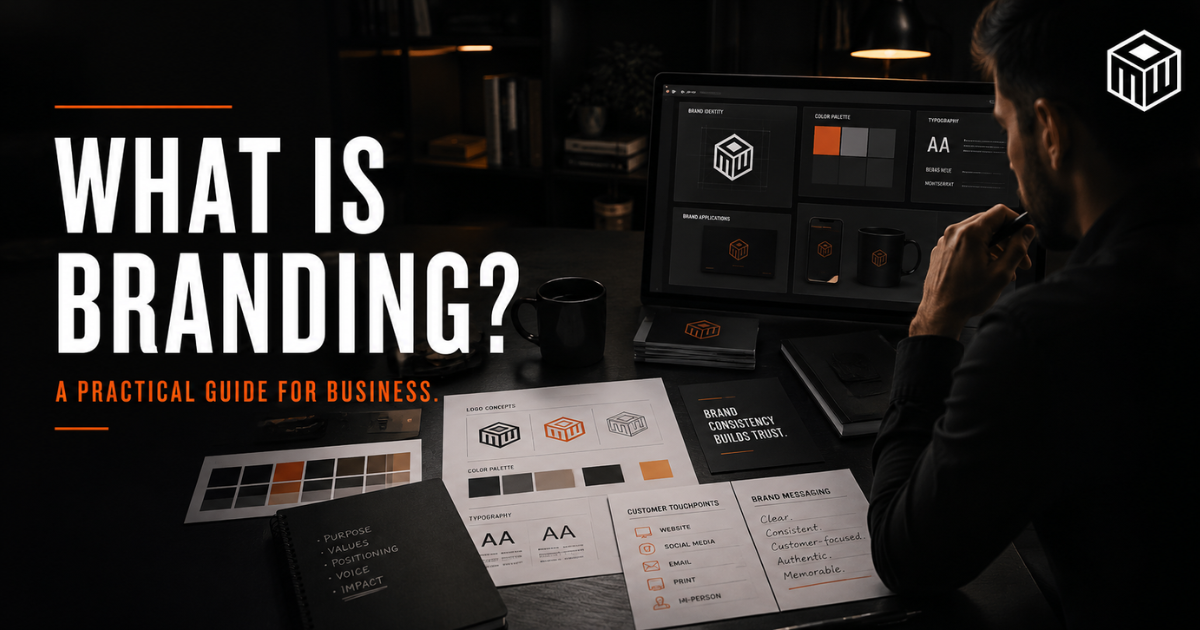
What Is Branding? A Practical Guide for Business
The terms are closely related, but they are not exactly the same.
A brand is the collection of ideas, expectations, associations, and experiences connected with a business.
Branding is the work a company does to intentionally shape those associations.
Think about the difference this way.
A company can choose its name, logo, colors, messaging, positioning, photography, website, packaging, advertising, and customer-service standards. Those are branding decisions.
Customers then interpret those signals through their own experiences with the company.
The business can influence its reputation and perception, but it cannot simply declare what every customer will think.
That is why good branding requires more than creating attractive marketing materials. What the company promises and what customers actually experience need to support one another.
Professional
branding services can help businesses establish that foundation deliberately instead of allowing unrelated design and marketing decisions to accumulate over time.
Is Branding Just a Logo?
No.
A logo is one element of a visual brand identity.
It can help identify the business and make the company more recognizable, but it cannot communicate the entire brand by itself.
Imagine two businesses using equally professional logos.
One communicates clearly, delivers consistently, understands its customers, has a recognizable personality, and provides a strong customer experience.
The other changes its message constantly, uses inconsistent visuals, makes unclear promises, and provides an unpredictable experience.
The logos may be equally polished, but the brands are not equally strong.
Branding can include:
- Brand strategy
- Target audience
- Positioning
- Value proposition
- Brand messaging
- Brand voice
- Visual identity
- Logo system
- Colors
- Typography
- Photography and imagery
- Brand guidelines
- Customer experience
- Reputation
- Marketing consistency
A logo answers an important visual question: How should people recognize us?
Branding addresses a much larger question:
What should this business mean to the people it wants to serve?
What Does a Brand Strategy Include?
Brand strategy provides direction for the decisions that shape the brand.
Without strategy, companies can end up choosing colors, writing taglines, redesigning logos, or publishing marketing campaigns before they have established what the business should actually communicate.
A brand strategy can address questions such as:
- Who are we trying to serve?
- What problems do those customers need solved?
- What alternatives are they considering?
- Why should they choose us?
- What do we want to be known for?
- What can we credibly promise?
- How should we communicate?
- What kind of experience should customers expect?
- How should the brand remain consistent as the company grows?
The answers create a framework for later decisions.
For example, a business positioned around personalized expert service may communicate differently from a competitor positioned around speed and convenience.
Neither position is automatically better.
The important question is whether the position is relevant to the intended customer, differentiated from realistic alternatives, and supported by the company's actual capabilities.
Why Does a Business Need to Define Its Target Audience?
A brand cannot communicate effectively if it is trying to speak to everyone in exactly the same way.
Different customers care about different problems, priorities, risks, and outcomes.
Understanding the intended audience helps a business make better decisions about positioning, messaging, content, design, offers, and marketing channels.
Consider a company selling the same technical service to two types of buyers.
One customer may care most about price and speed.
Another may place greater importance on reliability, compliance, long-term support, and reduced risk.
The service may be similar, but the information each customer needs before making a decision can be very different.
Defining an audience does not necessarily mean refusing to serve everyone outside a narrow demographic.
It means understanding who the brand is primarily designed to reach and what matters to those people.
What Is Brand Positioning?
Brand positioning defines how a business wants to occupy a meaningful place relative to the alternatives customers are considering.
Good positioning helps answer:
- Why should the right customer choose this business instead of another option?
That difference might involve specialization, expertise, process, convenience, service model, quality, customer experience, local knowledge, product design, values, or another relevant factor.
The difference should be real.
A company does not create meaningful positioning by simply claiming to be “the best,” “high quality,” or “customer focused.” Competitors can make the same statements.
Useful positioning is more specific.
For example, a company might specialize in a particular industry, solve an unusually difficult type of problem, offer a distinctive process, or provide a service model designed around a specific customer need.
Strong branding helps make that difference understandable.
What Is a Brand Value Proposition?
A value proposition explains why a customer should consider choosing a particular business, product, or service.
It connects what the company provides with what the customer actually values.
A useful value proposition normally addresses some combination of:
- Who the offer is for
- What problem it solves
- What outcome it provides
- Why the approach is different
- Why the customer should believe the claim
The value proposition does not need to appear as one formal sentence everywhere.
It should, however, influence how the business communicates across its website, sales materials, advertising, and other customer interactions.
When a company cannot clearly explain its value proposition internally, its external marketing often becomes inconsistent.
Different employees describe the company differently. Website pages make different promises. Advertisements focus on unrelated benefits.
Brand strategy provides a common foundation.
What Is Brand Messaging?
Brand messaging turns strategy into language customers can understand.
It includes the main ideas a company communicates about itself, its products or services, its customers, and the problems it solves.
Messaging may influence:
- Website headlines
- Service descriptions
- Advertisements
- Sales presentations
- Social media
- Email marketing
- Brochures
- Proposals
- Calls to action
- Company descriptions
- Customer communications
Good messaging is not simply a collection of clever slogans.
It should help customers understand what the company offers and why it matters.
The strongest messaging usually begins with customer relevance rather than company self-praise.
Instead of filling a website with vague statements about excellence, innovation, or passion, useful messaging explains what the business actually does, who it helps, how it works, and why the difference matters.
When a business needs to carry those ideas into educational articles and campaigns, professional
content marketing services can help turn the brand message into useful ongoing communication.
What Is Brand Voice?
Brand voice describes the recognizable way a business communicates.
A brand might sound:
- Professional
- Conversational
- Technical
- Reassuring
- Direct
- Energetic
- Sophisticated
- Friendly
- Educational
The appropriate voice depends on the company, audience, situation, and brand strategy.
A financial professional and a children's entertainment company probably should not communicate in exactly the same style.
Consistency matters, but brand voice should not become rigid.
The tone of a serious customer-service response may differ from the tone of a social media announcement while still feeling like the same company.
Good brand voice creates recognizable communication without making every sentence sound formulaic.
What Is a Visual Brand Identity?
Visual brand identity is the system of visual elements used to represent a brand.
That can include:
- Logo
- Brand colors
- Typography
- Icons
- Graphic elements
- Photography style
- Illustration style
- Layout conventions
- Patterns
- Marketing templates
- Signage
- Packaging
- Digital graphics
These elements should work together rather than being selected independently.
For example, a logo can look professional by itself while clashing with the typography, photography, or website surrounding it.
A visual identity creates a broader system that helps materials look related.
This is where branding and graphic design overlap.
Branding establishes what the company needs to communicate and the broader identity behind it.
Professional graphic design services
help express that identity consistently across visual materials.
Why Does Brand Consistency Matter?
Customers rarely experience a brand in only one place.
Someone might first discover a company through search, visit its website, read reviews, see a social media profile, receive an email, speak with an employee, and later receive a proposal.
Each interaction contributes to an overall impression.
Consistency helps those experiences feel connected.
That does not mean every marketing piece must look identical or repeat the same sentence.
It means the underlying identity remains recognizable.
The same general positioning, message, visual system, and level of professionalism should carry across important touchpoints.
Inconsistency can create uncertainty.
If an advertisement presents a premium company but the website looks neglected, those signals conflict.
If the website emphasizes personal service while customer communications feel impersonal, the promise and experience conflict.
If different marketing materials use unrelated colors, logos, typography, and language, the business becomes harder to recognize.
Consistency reinforces memory and credibility because the customer repeatedly encounters the same underlying business identity.
How Does a Website Affect a Company's Brand?
For many customers, the website is one of the most important places where the brand becomes tangible.
The website combines messaging, visual identity, information architecture, content, photography, usability, and customer experience in one place.
A company may have a strong logo and clear positioning, but those strengths can be weakened if the website is difficult to use or communicates something different.
A good branded website should help visitors understand:
- What the company does
- Who it serves
- What makes it different
- What kind of experience customers can expect
- Whether the company appears credible
- What the visitor should do next
The digital experience should therefore support the brand strategy rather than treating branding as a logo placed in the corner of an unrelated design.
Businesses developing or updating that experience can connect brand strategy with
custom web design services so visual design, messaging, usability, and customer expectations work together.
Does Customer Experience Affect Branding?
Yes.
Branding is not limited to marketing communication.
The experience customers actually receive influences how they perceive and describe the company.
Suppose a business brands itself around responsiveness.
If emails regularly go unanswered for days, the customer experience contradicts the brand promise.
A business positioned around simplicity cannot create a complicated buying process without creating tension between the promise and the experience.
Likewise, a company emphasizing expertise must demonstrate that expertise through the quality of its work, communication, content, and customer interactions.
This is why branding cannot fix a poor customer experience simply by changing visual identity.
Design can change expectations.
Operations determine whether those expectations are fulfilled.
The strongest brands create alignment between what they say and what customers actually experience.
How Does Reputation Relate to Branding?
Branding and reputation are connected but not identical.
Branding represents the company's deliberate effort to establish an identity and communicate its value.
Reputation reflects how other people actually perceive the business based on experiences, reviews, conversations, recommendations, and other evidence.
A business can influence reputation through good work, clear communication, consistent service, useful information, and responsible responses to problems.
But reputation cannot be completely controlled through marketing.
That distinction matters because branding should be credible.
If a company makes promises the customer experience does not support, stronger marketing may amplify the mismatch rather than solve it.
Good branding should clarify authentic strengths instead of manufacturing claims the business cannot consistently deliver.
Does a Small Business Really Need Branding?
Yes, although the appropriate level of branding work depends on the business.
Every business develops a brand in some form because customers naturally form impressions.
The real question is whether those impressions are being shaped deliberately or left largely to chance.
Small businesses can particularly benefit from clarity.
They may not have the advertising budgets or widespread recognition of larger competitors. Clear positioning and consistent communication can help customers understand why a smaller business deserves consideration.
A small business does not necessarily need an enormous brand manual or a complicated strategy exercise.
It does need clear answers to important questions:
- Who are we serving?
- What are we offering?
- What makes us meaningfully different?
- What should customers expect?
- How should we communicate that consistently?
Those answers can improve decisions across websites, sales materials, advertising, social media, customer communication, and design.
For more details, see Why Branding Matters for Small Businesses Today.
How Do You Know if Your Branding Is Weak?
Weak branding does not always mean the logo looks outdated.
The deeper problem is often inconsistency or lack of clarity.
Common warning signs include:
- Employees describe the business in completely different ways.
- Customers regularly misunderstand what the company offers.
- Marketing focuses mostly on generic claims competitors could also make.
- Visual materials look unrelated.
- The website communicates a different personality from other channels.
- The company struggles to explain why customers should choose it.
- Different campaigns target very different audiences without a clear strategy.
- Messaging changes every time new marketing materials are created.
- The brand no longer reflects how the business has evolved.
- Customers expect something different from what the company actually provides.
Not every inconsistency requires a complete rebrand.
Sometimes the business already has a strong strategic foundation but needs clearer guidelines or better implementation.
In other cases, the underlying positioning and message themselves need reconsideration.
What Should a Business Define Before Designing a Brand?
It is tempting to begin branding by choosing a logo style or color palette.
Those decisions are easier to make when the strategic foundation comes first.
Before focusing heavily on visual identity, define:
Who You Serve
Identify the customers the brand needs to reach and understand the problems, priorities, and decisions that matter to them.
What You Offer
Clearly define the products, services, or experiences the company provides.
What Makes You Different
Determine which differences are meaningful to customers and which claims the business can genuinely support.
What You Want to Be Known For
Choose the ideas the company wants customers to associate with the business over time.
What You Promise
Clarify the experience or value customers should reasonably expect.
How You Should Communicate
Establish the message and voice that best express the strategy.
Once those areas are clear, visual decisions can reinforce them instead of trying to create a strategy through design alone.
What Makes Branding Effective?
Effective branding creates alignment.
The strategy, message, identity, and experience should reinforce one another.
A practical way to evaluate a brand is to ask:
Is it clear?
Can customers understand what the company offers and why it matters?
Is it relevant?
Does the brand address priorities that actually matter to the intended customer?
Is it differentiated?
Can customers identify a meaningful reason to choose this business rather than an alternative?
Is it credible?
Can the company support the promises it makes?
Is it consistent?
Do important customer touchpoints feel like they come from the same organization?
Is it usable?
Can employees, designers, marketers, and other partners apply the brand in real situations?
A branding system that only looks good in a presentation but is difficult to use in everyday business communication is incomplete.
Good branding should make future decisions easier.
Frequently Asked Questions
What is branding in simple terms?
Branding is the process of intentionally shaping how a business presents itself and what customers associate with it.
It includes strategy, positioning, messaging, voice, visual identity, and the customer experiences that reinforce those ideas.
What are the main elements of branding?
Common branding elements include target audience, positioning, value proposition, messaging, brand voice, logo, colors, typography, imagery, brand guidelines, and customer experience.
The exact system depends on the business and its needs.
What is the difference between branding and marketing?
Branding defines the identity, positioning, message, and expectations surrounding the business.
Marketing uses channels and campaigns to communicate offers, attract attention, generate demand, and move customers toward action.
Branding helps determine what the business should communicate. Marketing helps distribute and activate that communication.
What is the difference between branding and graphic design?
Branding establishes the strategic identity of a business, including positioning, messaging, personality, and broader visual direction.
Graphic design is the practice of creating visual communication.
Graphic design can express a brand through materials such as advertisements, brochures, social graphics, presentations, signage, and website assets, but branding extends beyond the visual execution.
Can a business have a brand without a logo?
Yes.
People can develop expectations and associations with a business even without a formal logo.
A logo makes identification and consistent visual communication easier, but it does not create the entire brand.
When should a business consider rebranding?
A business may consider rebranding when its current identity no longer reflects its strategy, audience, positioning, services, reputation, or direction.
Rebranding may also become relevant after major growth, market changes, mergers, significant business changes, or persistent confusion about what the company represents.
Not every visual problem requires a complete rebrand.
Is branding only important for large companies?
No.
Small businesses also benefit from clear positioning, consistent messaging, recognizable visual identity, and a customer experience that supports the promises they make.
The complexity of the branding process may differ, but the underlying need for clarity applies to businesses of many sizes.
How long does it take to build a brand?
A branding project can establish strategy, messaging, and identity within a defined project timeline, but a brand itself develops over time.
Recognition and reputation grow through repeated customer experiences and consistent communication.
Launching a visual identity is therefore not the same thing as finishing the work of building a brand.
Conclusion
Branding is much more than choosing a logo.
It is the deliberate process of defining what a business stands for, who it serves, how it differs, what it promises, how it communicates, how it looks, and what customers should expect when they interact with it.
Strategy gives the brand direction.
Messaging puts that strategy into words.
Visual identity expresses it visually.
Customer experience and reputation determine whether the promise is believable.
When those elements work together, branding gives a business a clearer and more consistent identity across its website, marketing, sales process, social media, and other customer touchpoints.
The goal is not simply to make a business look different.
The goal is to make the business understandable, recognizable, relevant, and credible to the people it wants to serve.
If your business has outgrown its current identity, struggles to explain what makes it different, or lacks consistency across its website and marketing materials, the problem may require more than a new logo.
Muskogee Web Design's
professional branding services can help establish a clearer foundation for how your business is positioned, presented, and communicated.
You can also review the
Muskogee Web Design portfolio when evaluating our work.
When you are ready to discuss your business, current brand, and where you want it to go,
book a branding consultation.
Branding is often associated with logos, colors, fonts, and other visual elements. Those things matter, but they represent only part of a brand.
A business also communicates through its positioning, promises, language, customer experience, reputation, website, advertising, social media, sales process, and the way employees interact with customers.
Together, those experiences influence what people expect from the company.
Branding is the deliberate process of defining and shaping how a business is presented and perceived.
It includes decisions about who the business serves, what makes it different, what it promises customers, how it communicates, how it looks, and how consistently those ideas are expressed across customer touchpoints.
A logo may help someone recognize a company.
Branding gives that logo meaning.
What Is the Difference Between a Brand and Branding?
Related Articles

Author