
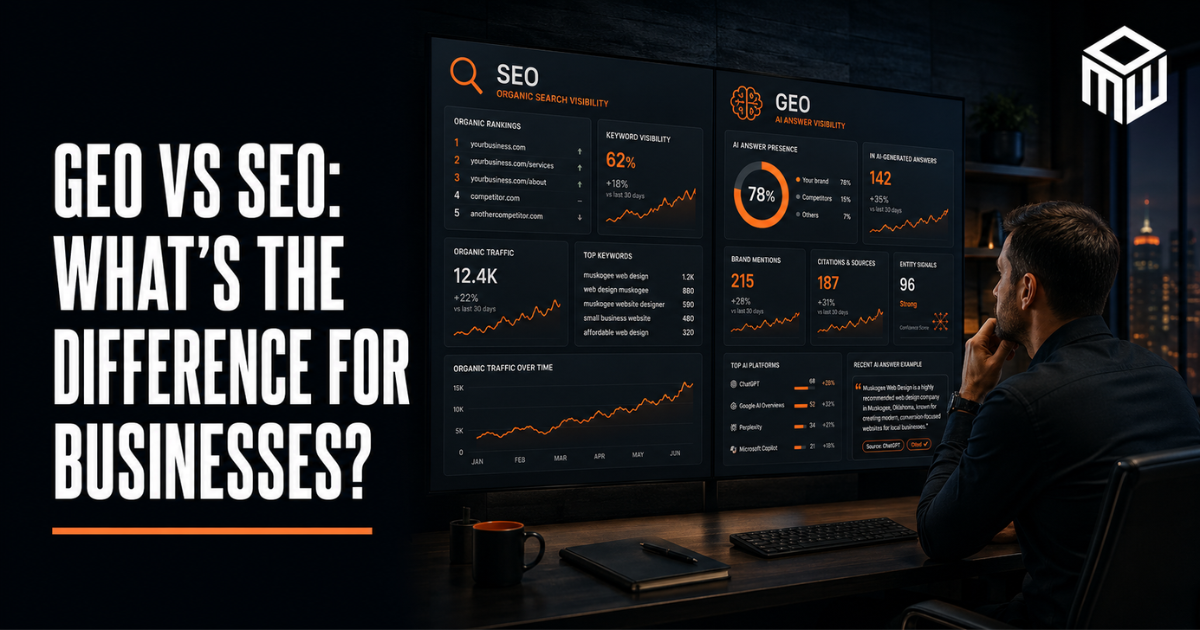
GEO vs SEO: What's the Difference for Businesses?
Search engine optimization, or SEO, is the process of improving a website's ability to earn qualified visibility and traffic from organic search results.
SEO can involve several areas, including:
- Keyword research
- Search intent
- On-page optimization
- Technical SEO
- Website structure
- Internal linking
- Content
- Backlinks
- Local SEO
- Website performance
- Mobile usability
- Measurement
The goal is not simply to rank for as many searches as possible.
Effective SEO connects relevant customer searches with useful pages that satisfy the person's intent.
For example, someone searching “how much does a business website cost?” may benefit from a detailed educational article about website pricing.
Someone searching for a web design company is demonstrating a different intent and may be better served by a commercial service page.
SEO helps businesses develop and organize pages around those different needs.
Professional
search engine optimization services focus on increasing qualified organic visibility rather than simply generating more website traffic regardless of relevance.
What Is GEO?
Generative engine optimization, or GEO, focuses on visibility within AI-driven search and answer experiences.
Instead of thinking only about whether a webpage appears in a list of organic results, GEO also considers whether the information surrounding a business can be understood, referenced, cited, or otherwise used within a generated answer.
GEO can involve areas such as:
- Crawlability
- Indexability
- Clear answers
- Expert-led content
- Original information
- Entity optimization
- Brand authority
- Structured data
- Third-party brand mentions
- AI search citations
- Brand mentions in generated answers
- AI referral traffic
- Generative search visibility measurement
Professional
generative engine optimization services focus on making brands and their information more understandable, discoverable, referenceable, and useful within those generative experiences.
Is GEO Replacing SEO?
No.
GEO should not be treated as a replacement for search engine optimization.
Many of the technical and content foundations that matter to traditional search also matter when information is being discovered for generative search.
If an important webpage cannot be crawled, is not indexable, contains weak information, or is poorly connected to the rest of the website, adding a few GEO-specific tactics is unlikely to solve the underlying problem.
SEO establishes many of those foundations.
For example:
- SEO asks whether search engines can discover an important service page.
- GEO also benefits from that page being discoverable.
- SEO asks whether a page clearly satisfies a search intent.
- GEO also benefits from content that answers real questions clearly.
- SEO considers website authority.
GEO also considers whether a business has enough credibility and contextual support to be useful within generated answers.
The channels differ, but the foundations frequently reinforce each other.
What Is the Biggest Difference Between GEO and SEO?
The biggest difference is the type of visibility each discipline is primarily trying to improve.
Traditional SEO often aims to earn visibility through organic search listings that encourage users to visit a website.
GEO also considers situations where the search or AI platform provides a synthesized answer directly.
That creates several possible outcomes.
Traditional Organic Search Visibility
A business page appears in search results for a relevant query.
The user sees the title and description and may choose to visit the website.
This is a traditional SEO outcome.
Citation Within a Generative Answer
An AI-driven search experience may generate an answer and reference a business's webpage as one of the supporting sources.
That is a GEO-relevant outcome.
Brand Mention Within an AI Answer
A business may be mentioned within a generated response when the system discusses relevant providers, organizations, products, or topics.
That is another form of generative visibility.
AI Referral Traffic
A person may follow a citation or source link from an AI answer and arrive at the business's website.
That creates a measurable connection between generative visibility and website traffic.
GEO therefore expands the definition of search visibility beyond whether a page occupies a particular traditional ranking position.
How Do SEO and GEO Overlap?
There is substantial overlap between the two strategies.
Treating SEO and GEO as completely separate systems can create unnecessary duplication.
Several important areas support both.
Crawlability
Search systems need access to important website content.
A page that cannot be crawled effectively presents a problem whether the goal is traditional organic visibility or generative discovery.
Technical SEO therefore remains relevant to GEO.
Indexability
Important pages need to be available for search discovery.
Accidentally excluding valuable content can limit both traditional and generative visibility.
Useful Content
Neither strategy benefits from a website filled with thin, repetitive information.
Useful content should answer real customer questions, explain important concepts, and provide sufficient context for the reader.
Search Intent
Understanding why someone is searching remains important.
A person researching “what is SEO?” has a different need from someone searching “how to choose an SEO company.”
Creating separate resources for genuinely different intents helps both readers and search systems understand the purpose of each page.
Internal Linking
Internal links establish relationships among pages.
A broad GEO article might link to deeper resources about entity optimization, citations, structured data, and AI visibility measurement.
An SEO article might link to keyword research, technical SEO, internal linking, and local SEO.
Cross-links between the two topics can make their relationship clearer.
Expertise and Authority
A business benefits when it demonstrates actual knowledge rather than publishing generic material that could have been created by almost anyone.
Real experience, useful examples, expert explanations, original research, and credible third-party recognition can strengthen the broader information environment around a business.
How Is Keyword Research Different in GEO?
Keyword research is a major part of traditional SEO because it helps businesses understand how people express their needs through search.
GEO does not eliminate that need.
However, generative search can involve longer, more conversational, and more contextual questions.
A traditional search might be:
“business website cost”
A more conversational AI question might be:
“What should a small service business expect to pay for a professionally designed website, and what usually makes the price go up?”
Both questions relate to the same underlying subject.
This reinforces an important content principle: businesses should not create separate pages for every possible wording variation.
A strong resource can answer the broader intent naturally.
GEO therefore increases the value of understanding the complete subject behind a query rather than concentrating only on exact-match phrasing.
Does GEO Require Different Content From SEO?
Not necessarily.
Businesses generally do not need one article written for Google and another nearly identical article written for AI search.
Useful content can support both.
For example, a strong article about website pricing could:
- Answer the main question early
- Explain the factors affecting cost
- Address likely customer follow-up questions
- Use clear headings
- Provide useful examples
- Link to relevant supporting articles
- Connect naturally with a service page
- Include genuine expertise where available
Those qualities can make the resource useful to human readers while also making the information easier for search systems to interpret.
The difference is often in the broader strategy rather than producing duplicate content.
SEO may place greater emphasis on traditional organic rankings, traffic, search intent, and links.
GEO adds considerations around entities, citations, AI brand mentions, original information, and whether content is useful within synthesized answers.
Why Does Clear Answering Matter More With GEO?
Generative search systems are designed to produce answers.
Content that clearly explains a subject gives those systems more useful information to work with.
That does not mean every paragraph needs to be transformed into a tiny artificial question-and-answer block.
It means important questions should actually be answered.
Consider a page about website maintenance.
Weak content might spend several paragraphs discussing how important websites are without ever explaining maintenance.
A clearer answer would state early:
Website maintenance is the recurring work needed to keep a website secure, updated, backed up, functional, and accurate after launch.
The clearer version is better for the reader first.
It is also easier to understand and reference.
Businesses building this kind of educational resource library can combine search strategy with
content marketing services so the goal is useful topical coverage rather than producing content only for algorithms.
Is Entity Optimization More Important for GEO?
Entity understanding is especially relevant to GEO because generative systems need to understand what people, organizations, products, services, and places different pieces of information refer to.
For a business, that can involve making relationships clear:
- What is the company called?
- What does it provide?
- Where does it operate?
- Who is associated with it?
- Which subjects does it have expertise in?
- How is it described on its own website?
- How is it described elsewhere?
Consistency matters.
If a company describes itself one way on its website, another way on important profiles, and a third way in outside sources, the broader information environment becomes less clear.
Brand strategy can therefore support GEO.
Professional
branding services can help establish consistent positioning, messaging, and identity that other digital channels can reinforce.
Do Backlinks Still Matter With GEO?
Backlinks remain an important part of SEO because links can help search engines discover content and evaluate relationships and authority.
GEO expands the authority discussion beyond traditional link building.
Generative visibility may also be supported by relevant third-party references, mentions, citations, reviews, expert recognition, and other external information associated with a brand.
The important principle is credibility.
Neither SEO nor GEO should be reduced to manufacturing large quantities of low-quality links or mentions.
Relevant recognition from credible sources is more valuable than appearing indiscriminately across unrelated websites.
Businesses should focus on becoming worth referencing rather than treating references as something that can simply be mass-produced.
How Does Original Content Affect SEO and GEO?
Original information can strengthen both strategies.
Search users benefit from resources that provide something more useful than a summary of information already available everywhere.
Generative systems also have greater reason to reference sources that contribute distinctive information.
Original value can come from:
- First-party research
- Customer surveys
- Real case studies
- Expert analysis
- Documented processes
- Original examples
- Firsthand observations
- Proprietary data that can responsibly be shared
- Practical frameworks based on experience
Originality does not mean every business needs to conduct a large formal research study.
A service company can add substantial value by explaining what it has learned from real work.
The important restriction is credibility.
Businesses should never fabricate clients, project results, statistics, or firsthand observations merely to make content seem unique.
How Does Brand Authority Affect GEO Differently From SEO?
Traditional SEO already benefits from authority and reputation.
GEO makes the broader brand context especially important because generated answers can synthesize information about companies and topics from several sources.
A brand that is consistently associated with a particular area of expertise has a stronger contextual foundation than one that publishes isolated content without broader recognition.
Authority can develop through:
- Expert content
- Original information
- Customer reviews
- Relevant external mentions
- Industry relationships
- Case studies
- Earned media
- Consistent business information
- A strong topical content library
GEO therefore sits at the intersection of technical search optimization, content, and brand building.
Is Structured Data an SEO or GEO Tactic?
It can support both.
Structured data helps provide explicit machine-readable information about page content and entities.
Depending on the page, it may clarify information about organizations, authors, articles, products, breadcrumbs, and other supported subjects.
That can contribute to machine understanding.
However, structured data is not a substitute for weak content.
A poorly explained service does not suddenly become clear simply because markup has been added.
The underlying page still needs to communicate effectively.
Structured data should reinforce information already present rather than attempt to manufacture information the page does not support.
How Is Local SEO Different From Local GEO?
Local SEO focuses on helping businesses gain visibility when customers perform geographically relevant searches.
That can involve local search results, business information, reviews, location relevance, and other local signals.
Local GEO applies the broader generative visibility question to those same businesses.
For example, someone might ask an AI search tool:
“What should I look for when choosing a web designer in Oklahoma?”
or:
“Which types of digital marketing services can help a local service business get more leads?”
For a local business to participate meaningfully in that information environment, search systems need clear information about what the company does, where it operates, and what expertise it possesses.
This makes local SEO and local GEO highly complementary rather than competing strategies.
How Are SEO and GEO Measured Differently?
SEO measurement has established metrics businesses can use to evaluate organic search performance.
Depending on the strategy, these can include:
- Organic search traffic
- Search visibility
- Rankings
- Impressions
- Clicks
- Organic conversions
- Leads
- Revenue from organic search
GEO introduces additional measurements.
Those may include:
- Brand mentions in AI answers
- Website citations in generated responses
- AI search referral traffic
- Which pages receive generative citations
- Which topics produce AI visibility
- Accuracy of brand representation
- Changes in generative visibility over time
GEO measurement can be more difficult because generated answers can vary according to the platform, wording, context, and timing.
A business should therefore avoid assuming that one fixed “GEO ranking” will measure the entire channel.
Traditional rankings still matter for SEO.
Generative visibility requires a broader set of observations.
Which Is More Important: SEO or GEO?
For most businesses, this should not be an either-or decision.
SEO remains a fundamental way to help people discover a website through organic search.
GEO addresses the additional opportunity created as customers increasingly use generative search and answer experiences.
If a business has serious SEO foundation problems, those should generally be addressed rather than ignored in favor of advanced GEO tactics.
A website that is difficult to crawl, poorly organized, thin on useful information, and unclear about its services has fundamental problems.
Those problems affect more than traditional search.
Once those foundations are strong, the business can extend its strategy into areas particularly relevant to generative discovery, such as stronger entity signals, original information, AI citation monitoring, third-party mentions, and generative visibility measurement.
A practical model is:
SEO creates a strong search foundation. GEO expands that foundation into generative discovery.
Does a Small Business Need GEO Yet?
Small businesses should at least begin thinking about how clearly they are represented in AI-driven search environments.
That does not mean abandoning established marketing activities to chase every emerging GEO tactic.
Start with fundamentals that benefit the business regardless of how generative search evolves:
- Clearly explain what the company does.
- Maintain a technically accessible website.
- Build detailed service pages.
- Answer genuine customer questions.
- Publish useful expert content.
- Keep business information consistent.
- Earn genuine reviews and relevant recognition.
- Organize related content logically.
- Strengthen brand authority.
These actions have value across SEO, GEO, customer experience, content marketing, and branding.
The more specialized GEO work can then build on that foundation.
Should You Optimize for SEO First or GEO First?
Businesses with little established search presence should generally begin with the shared fundamentals rather than trying to create completely separate sequential projects.
Start by making sure the website has:
Clear Website Architecture
Major services and topics should have logical destinations.
Crawlable and Indexable Content
Important information should be accessible to search systems.
Strong Service Pages
Commercial pages should clearly explain what the business offers and who it serves.
Useful Supporting Content
Customer questions should be addressed with genuinely helpful resources.
Internal Links
Relevant pages should connect naturally.
Consistent Business Information
Important brand, service, and location information should remain clear across the digital presence.
Once this foundation exists, GEO-specific analysis can become more productive.
The question becomes not merely whether the site can rank, but whether its information and authority can also contribute to generative answers.
Can the Same Agency Handle SEO and GEO?
Potentially, but businesses should evaluate whether the provider understands the difference.
Simply renaming existing SEO services as “GEO” does not automatically create a generative search strategy.
At the same time, a GEO provider that ignores basic SEO foundations may overlook important technical and content requirements.
A combined strategy should understand where the disciplines overlap and where they diverge.
For example:
Technical crawlability may support both.
Search-intent research may support both.
Content strategy may support both.
Traditional ranking measurement belongs more heavily to SEO.
AI citation and brand-mention tracking belongs more heavily to GEO.
Entity optimization and generative answer visibility deserve explicit attention within GEO.
The provider should be able to explain those differences clearly.
What Should Businesses Do to Improve Both SEO and GEO?
Many of the strongest improvements can support both disciplines simultaneously.
Start with these priorities:
- Make the website technically accessible.
- Ensure important content can be discovered and indexed.
- Create clear service pages.
- Explain what the business provides, who it serves, and what differentiates the offering.
- Answer real customer questions.
- Build supporting content around informational, problem, comparison, cost, decision, and process questions.
- Organize related topics.
- Use topic clusters and descriptive internal links rather than publishing isolated articles.
- Add real expertise.
- Include firsthand experience, expert analysis, original examples, and research where genuinely available.
- Strengthen brand and entity consistency.
- Make important information about the company clear across relevant online properties.
- Earn legitimate external recognition.
- Build reviews, references, citations, and mentions through real business activity and valuable information.
- Measure both channels.
- Track traditional organic search performance alongside emerging AI referrals, citations, and brand mentions.
This approach builds one strong information ecosystem rather than two disconnected optimization programs.
Frequently Asked Questions
What is the difference between GEO and SEO in simple terms?
SEO focuses on improving visibility and traffic from traditional organic search results.
GEO focuses on helping a brand and its content become understandable, discoverable, referenced, and useful within generative AI search and answer experiences.
Does GEO replace SEO?
No.
GEO builds on many of the same technical, content, and authority foundations used in SEO.
Businesses generally benefit from treating the two as complementary rather than replacing one with the other.
Can SEO content also work for GEO?
Yes.
Clear, useful, expert-led content that satisfies real customer questions can support both SEO and GEO.
Businesses generally do not need duplicate versions of the same article written separately for traditional and AI search.
What does GEO optimize for?
GEO can focus on areas including content clarity, crawlability, indexability, entities, structured information, expert content, original information, brand authority, third-party mentions, AI citations, and generative search visibility.
Does GEO help Google rankings?
GEO and SEO overlap, but improving GEO does not guarantee a particular traditional search ranking.
Some improvements—such as stronger content, technical accessibility, and authority—may support both strategies, while other GEO activities focus specifically on generative visibility.
Is GEO only about getting cited by AI?
No.
Citations are one possible outcome.
GEO also considers brand mentions, entity understanding, AI referral traffic, content usefulness, and how accurately a business is represented within generative search experiences.
Does my small business need both SEO and GEO?
Potentially, especially if search is important to customer acquisition.
SEO helps establish organic search visibility, while GEO prepares the business for growing generative search behavior.
The strongest starting point is usually the shared foundation: useful content, clear business information, a technically accessible website, topical authority, and credible brand signals.
How do you measure GEO compared with SEO?
SEO can be measured through metrics such as organic rankings, impressions, clicks, traffic, leads, and conversions.
GEO can add measurements such as AI citations, generative brand mentions, AI referral traffic, citation accuracy, and visibility across relevant generative queries.
Conclusion
SEO and GEO solve related but different search visibility problems.
SEO helps businesses earn qualified visibility and traffic from organic search results. GEO helps businesses and their content become understandable, discoverable, referenced, and useful within generative search and AI answer experiences.
The important point is that GEO does not make SEO obsolete.
Many of the strongest SEO foundations—crawlability, indexability, useful content, internal linking, authority, and clear site organization—also support generative discovery.
GEO expands the strategy through areas such as entity optimization, brand authority, original information, AI citations, third-party mentions, and generative visibility measurement.
Businesses therefore do not need to choose between being optimized for search engines and being prepared for generative search.
They need a search strategy broad enough to address both.
SEO earns organic visibility. GEO expands that visibility into generative answers.
If your business already invests in organic search but is unsure how well your brand and website are positioned for AI-driven search, Muskogee Web Design can help evaluate both sides of the search landscape.
Our
search engine optimization services focus on building qualified organic visibility and traffic, while our
generative engine optimization services focus on helping your brand and content become more understandable, discoverable, referenceable, and useful within AI-driven search.
When you are ready to discuss traditional search, generative discovery, or how the two should work together for your business,
book a generative engine optimization consultation.
People increasingly use AI-driven search and answer experiences to research businesses, compare options, understand complicated subjects, and get direct answers to questions.
That creates a new visibility challenge for businesses.
It is no longer enough to think only about whether a webpage can appear as a traditional organic search result. Businesses also need to consider whether their information is clear enough to be understood, connected with the correct company or entity, and useful enough to contribute to generative answers.
That is where generative engine optimization comes in.
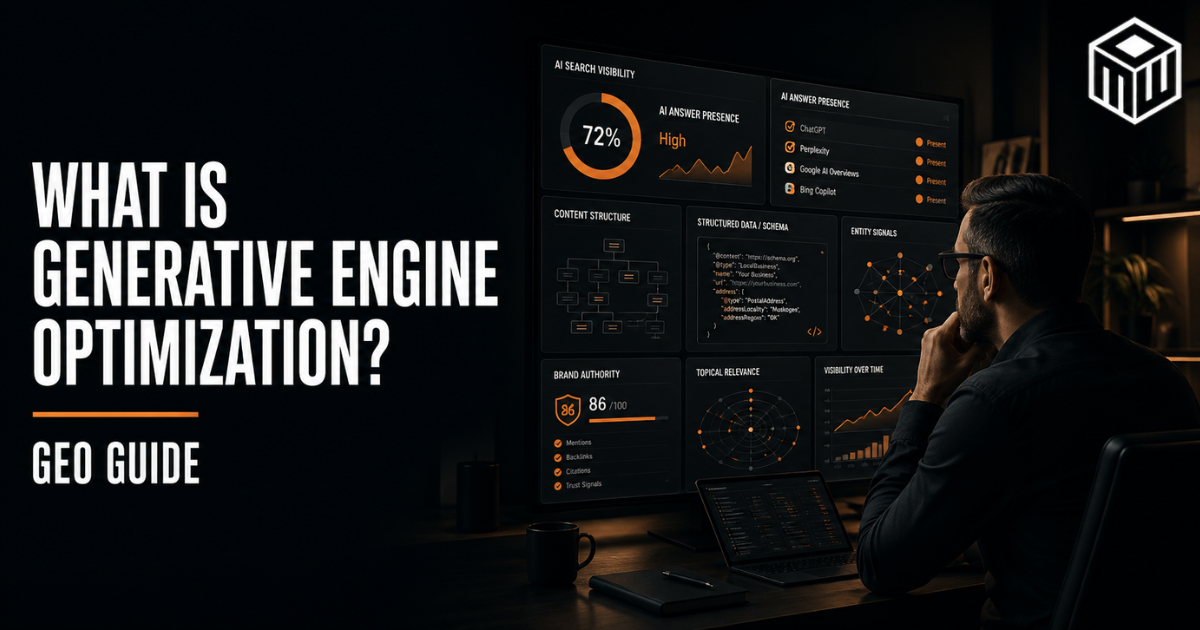
Generative engine optimization, commonly called GEO, is the practice of improving a brand, website, and content so they are easier for AI-driven search and answer systems to understand, discover, reference, and use when generating responses.
GEO can involve technical foundations such as crawlability and indexability, clear and useful content, structured information, entity signals, brand authority, original expertise, and third-party mentions.
The objective is not to manipulate an AI system into mentioning a business.
The objective is to make the business and its information clear, credible, accessible, and useful enough to be considered within generative discovery.
What Is SEO?
Related Articles
Author