

What Does a Social Media Manager Do for Business?
A social media manager helps keep the business's social channels organized, active, professional, and responsive.
That responsibility usually extends across the entire publishing process.
Before a post goes live, the manager may help plan the topic, prepare or coordinate the content, collect the necessary media, route the post through approval, and schedule publication.
After publication, the manager may monitor reactions, respond to appropriate comments and messages, moderate problematic activity, document recurring customer questions, and review performance.
Depending on the organization, a social media manager may also coordinate with designers, content marketers, business owners, customer-service teams, sales staff, or other employees who provide information needed for the accounts.
Professional
social media management services can provide this ongoing operational structure when a business does not want to manage the entire process internally.
Does a Social Media Manager Create the Content Calendar?
Content planning is one of the central responsibilities associated with social media management.
A content calendar gives the manager a structured view of what the business intends to publish and when.
Rather than deciding what to post at the last minute, a manager can organize upcoming content around relevant subjects such as customer questions, services, company updates, educational information, projects, events, or other topics appropriate to the business.
A calendar may help track details such as the platform, publishing date, content topic, status, media assets, and approval requirements.
The objective is not to eliminate flexibility.
Businesses may still need to respond to timely developments or unexpected opportunities. The calendar creates a reliable foundation so routine publishing does not depend entirely on last-minute decisions.
Does a Social Media Manager Write Posts?
Writing or coordinating social media copy can be part of the role.
The manager may prepare captions, headlines, short educational posts, announcements, questions, calls to action, or other platform-specific copy.
The content should reflect the business rather than sounding different every time a new person writes a post.
That requires understanding the company's:
- Brand voice
- Services
- Audience
- Current priorities
- Approved terminology
- Communication standards
A good social media manager also knows when information needs to come from someone else.
They should not guess about technical details, pricing, policies, customer situations, or company decisions simply because a post needs to be finished.
Effective management depends on access to accurate information from the business.
When the company needs a broader system for creating educational material across its website and other channels, social content can connect with
content marketing services rather than functioning as an isolated stream of posts.
Does a Social Media Manager Create Graphics and Videos?
Sometimes.
The answer depends on the manager's skill set and the scope of the service.
Some social media managers create routine graphics themselves. Others coordinate with a graphic designer, photographer, videographer, or internal creative team.
For example, we create the copy and graphics when we manage a social account, however we rely on the business to provide professional photography and videos.
A manager may be responsible for determining what type of visual asset a post needs even when another specialist creates it.
For example, the manager may identify the need for a branded educational graphic, provide the message and specifications, coordinate the design, route it through approval, and then publish the completed asset.
More specialized visual work may be handled through
professional graphic design services.
This division allows the social media manager to remain focused on the overall content and account workflow while specialized creative work is handled appropriately.
Does a Social Media Manager Schedule Posts?
Scheduling is another common responsibility.
Once content has been written, reviewed, and approved, the social media manager can prepare it for future publication.
Scheduling creates consistency without requiring someone to manually publish every piece of routine content at the exact moment it needs to appear.
It can be especially useful for:
- Educational content
- Company updates
- Recurring content
- Event reminders
- Planned announcements
- Evergreen posts
Scheduling should not make the account feel unattended.
The manager still needs to monitor what happens after publication and recognize when a scheduled post may no longer be appropriate because circumstances have changed.
The publishing tool handles timing.
The social media manager remains responsible for judgment.
Does a Social Media Manager Respond to Comments and Messages?
Community engagement can be an important part of the role.
Businesses receive different kinds of interactions through social channels.
Someone may ask about hours, services, availability, locations, appointments, products, or another routine subject.
Other messages may involve complaints, sensitive customer information, complicated sales questions, or problems requiring another employee.
The manager needs to understand the difference.
Routine interactions may be handled directly when the response is clear and authorized.
More complicated situations should be escalated.
That means good community management requires more than being friendly in the comments. The business needs to define what the manager is allowed to answer and where other issues should go.
A useful workflow helps prevent two opposite problems:
- The manager should not ignore questions that can easily be answered.
- They also should not invent answers to questions that require someone with greater authority or specialized knowledge.
What Is Community Management?
Community management focuses on the interactions surrounding a business's social presence.
A social media manager handling community responsibilities may monitor comments, answer appropriate questions, acknowledge positive interactions, identify recurring concerns, and help move customer conversations toward the appropriate next step.
This is different from publishing alone.
A company can maintain a regular posting schedule while still providing a poor social experience if customers repeatedly receive no response.
Community management recognizes that social channels allow two-way communication.
Does a Social Media Manager Handle Negative Comments?
Often, but handling negative comments requires judgment.
Not all negative interactions are the same.
A legitimate customer complaint is different from spam, harassment, or clearly inappropriate content.
A social media manager needs guidelines for deciding when to respond, when to escalate, and when moderation is appropriate.
For example, a customer describing a genuine service problem may need a professional acknowledgment and a path toward resolution.
A spam account repeatedly promoting unrelated products may require moderation rather than a customer-service response.
Automatically deleting every critical comment is not effective reputation management.
The role requires distinguishing reasonable criticism from activity that violates the business's moderation standards.
What Does Social Media Moderation Involve?
Moderation deals with inappropriate or disruptive activity within social spaces the business controls.
Depending on the account, the social media manager may need to address:
- Spam
- Harassment
- Offensive comments
- Repetitive promotions
- Inappropriate material
- Other content that violates established standards
Moderation decisions should be consistent.
Without a policy, decisions can become emotional or arbitrary.
One employee may delete criticism immediately while another leaves clearly abusive content untouched.
A manager benefits from established rules defining what should remain, what deserves a response, what should be hidden or removed, and what needs to be escalated.
How Does a Social Media Manager Maintain Brand Consistency?
Social media can become inconsistent quickly when several employees or outside contributors create content independently.
A social media manager helps maintain common standards across the accounts.
That can include consistency in:
- Brand voice
- Messaging
- Colors
- Typography
- Graphic style
- Logo usage
- Photography
- Company descriptions
Consistency does not mean every post needs to look identical.
The content should still adapt to its subject and platform.
What matters is that customers can recognize the same underlying business.
If the company's actual brand positioning, messaging, or voice has never been clearly defined, the manager may not have enough direction to maintain consistency.
That broader challenge may require
professional branding services before social media guidelines can be applied effectively.
Does a Social Media Manager Approve Every Post?
Not necessarily.
The manager may be the final approver in some organizations and part of a larger approval process in others.
The workflow depends on the business.
A small company might have the manager prepare content and the owner approve certain posts.
A larger organization may require review by marketing, legal, compliance, department leadership, or another stakeholder depending on the subject.
The social media manager often helps keep that process organized.
They may track whether a post is still being drafted, waiting on an image, pending approval, ready for scheduling, or already published.
This operational responsibility can be just as important as writing content.
A brilliant post that sits unapproved until three weeks after it was relevant does not help the business.
How Does a Social Media Manager Organize Photos and Videos?
Content production becomes difficult when nobody can find the company's media files.
Businesses may accumulate photographs and videos from employees, projects, events, products, customers, locations, and previous campaigns.
A social media manager may help maintain an organized system for those assets.
The process can include identifying which files are approved, what they show, where originals are stored, which assets have already been used, and which files are outdated.
This becomes more important as the number of accounts and contributors increases.
Without organization, businesses may repeatedly use the same images because nobody knows what else is available.
They may also waste time searching through phones, email attachments, shared drives, and old message threads for a particular file.
Does Social Media Management Include Graphic Design?
Monitoring activity can be part of the role.
A manager naturally watches comments and messages directed toward the company's own accounts.
The process may also extend into social listening—paying attention to relevant conversations, questions, feedback, or mentions beyond individual posts.
That information can reveal useful patterns.
For example, repeated questions may show that customers need clearer information.
A common misunderstanding could suggest a future educational post.
Recurring feedback might need to be shared with another department.
The manager therefore has an opportunity to bring customer observations back into the broader business rather than treating each social interaction as an isolated event.
Does a Social Media Manager Track Analytics?
Performance reporting is commonly part of social media management.
The manager may review how published content and managed accounts performed during a particular period.
Useful reporting depends on the business's goals, but it can include account and content activity such as engagement, audience changes, comments, messages, referrals, or other relevant indicators.
The purpose should be to improve decisions.
A report containing dozens of numbers has limited value if nobody knows what they mean or what should change as a result.
The social media manager should help connect performance information with practical questions:
- Which content appeared most useful to the audience?
- Which subjects generated conversation?
- Were there recurring customer questions?
- Are certain content formats worth using more often?
- Is the current publishing process sustainable?
- What should be adjusted next?
Which Metrics Does a Social Media Manager Watch?
The appropriate metrics depend on what the business expects the accounts to accomplish.
Follower growth alone is not enough to evaluate every social media program.
A manager may also need to examine engagement, comments, messages, content performance, referral activity, or other account-level indicators relevant to the social media management process.
The key distinction is between measurement and meaning.
A number increasing does not automatically mean the business is improving.
For example, a post could generate a large amount of engagement because customers are confused or upset.
That interaction should not be treated identically to positive engagement with useful content.
Metrics require context.
Is Account Security Part of a Social Media Manager's Job?
Account oversight can be part of social media management, particularly when several people need access.
Businesses should know who currently has permission to manage each account.
That becomes important when employees leave, agencies change, responsibilities move between departments, or temporary contractors no longer need access.
A social media manager may help maintain that structure by coordinating appropriate access and making sure old access does not remain indefinitely.
Businesses should avoid allowing account ownership to become dependent on one person's personal credentials whenever the platform provides a more appropriate business-management system.
If access problems are discovered only after the person controlling the account has left the company, transferring responsibility can become much more difficult.
What Does a Social Media Manager Do for Multiple Locations?
Managing multiple business locations adds another layer of coordination.
The manager may need to balance company-wide consistency with location-specific information.
Each location could have different employees, events, photos, hours, announcements, or customer interactions.
Without a process, location accounts can drift apart.
One location may post regularly while another is inactive. Profiles may contain inconsistent information. Different employees may interpret the brand voice differently.
A multi-location manager needs a system for collecting local information, maintaining central standards, managing approvals, and deciding which content belongs at the company level versus the location level.
What Is the Difference Between a Social Media Manager and a Content Creator?
The roles can overlap, but they are not necessarily identical.
A content creator focuses primarily on producing content.
That might involve writing, photography, video, graphics, or another format.
A social media manager has broader operational responsibility for the channels.
The manager may decide what content is needed, coordinate its creation, organize the calendar, schedule publication, handle engagement, maintain workflows, and prepare reports.
One person may perform both roles in a small business.
Larger teams may separate them.
The important distinction is that managing an account involves more than producing the individual assets appearing on it.
What Is the Difference Between a Social Media Manager and a Graphic Designer?
A graphic designer specializes in visual communication.
A social media manager oversees the ongoing social media process.
The social media manager may determine that a campaign needs several branded graphics and provide the necessary context.
The graphic designer then develops the visual assets.
Once approved, the social media manager schedules and publishes them as part of the broader content calendar.
Again, one person may possess both skill sets.
But businesses should not assume that someone hired to manage social media is automatically responsible for every specialized creative task required by the account.
Scope matters.
What Is the Difference Between a Social Media Manager and a Social Media Marketer?
This is one of the most important distinctions.
A social media manager focuses primarily on ongoing account operations such as content planning, publishing, scheduling, engagement, moderation, workflows, and account management.
Social media marketing focuses more heavily on strategic promotion, campaigns, audience growth, paid advertising, traffic, leads, sales, attribution, and ROI.
A manager may keep the company's social channels active and responsive.
A marketer may use those channels to launch a promotional campaign designed to generate a measurable business result.
The two areas can overlap and frequently work together, but they should not be treated as identical.
Businesses primarily seeking campaigns, advertising, growth, or lead generation may need
social media marketing services in addition to or instead of routine management.
Does a Social Media Manager Run Paid Ads?
Not automatically.
Some social media managers also have paid advertising responsibilities, but paid social belongs more directly to social media marketing.
Paid campaigns can involve separate work such as:
- Campaign strategy
- Audience targeting
- Budget management
- Advertising creative
- Landing pages
- Conversion tracking
- Campaign optimization
- Lead measurement
- ROI analysis
Those responsibilities go beyond keeping the organic social accounts active.
When hiring a social media manager or agency, businesses should clarify whether paid advertising is included rather than assuming it comes with routine account management.
Does a Social Media Manager Generate Leads?
A social media manager can support the environment in which lead generation occurs, but lead generation is not necessarily the primary responsibility of social media management.
The manager may help publish service information, maintain responsive accounts, direct customers toward useful website pages, and ensure inquiries are handled appropriately.
Strategic campaigns specifically designed around traffic, leads, sales, retargeting, offers, advertising, and conversion measurement fall more directly under social media marketing.
That distinction helps set realistic expectations.
A business should not judge routine account management entirely by whether every post creates immediate sales if generating sales was never the primary job assigned to the account.
What Does a Social Media Manager Need From the Business?
Even when social media management is outsourced, the manager still needs information from the company.
They may need updates about services, projects, staff, events, products, promotions, customer questions, policy changes, available photos, and other developments.
The business also needs to provide timely approvals when approval is required.
A social media manager cannot reliably communicate information they have never received.
The strongest working relationship gives the manager clear access to the information necessary to keep the accounts accurate.
That can involve a recurring process for collecting updates from the company rather than waiting until the manager has to repeatedly ask whether anything new is happening.
Should a Business Hire an In-House Social Media Manager?
It depends on the amount of work and the company's internal resources.
An in-house manager may benefit from being close to daily business operations and having direct access to employees, projects, events, and company information.
However, the business needs enough ongoing social media work to justify the role and must provide the necessary tools, processes, authority, and creative resources.
One common difficulty occurs when social media is added to an employee's existing responsibilities without reducing anything else.
The work then competes with responsibilities that may be more urgent.
As a result, social media repeatedly gets postponed.
The decision should be based on workload and responsibility rather than assuming that someone who uses social media personally will automatically be able to manage business accounts strategically and consistently.
Should a Business Hire a Social Media Manager or Agency?
Both models can work.
A dedicated manager may provide focused attention and integrate closely with the organization.
An agency may provide access to a broader collection of skills and resources depending on its service structure.
The appropriate choice depends on the business's goals, workload, number of accounts, content requirements, budget, and internal capacity.
The comparison deserves its own evaluation rather than treating one option as universally better.
How Do You Know if You Need a Social Media Manager?
A social media manager may be useful when the business knows its accounts should be maintained but lacks a reliable process for doing the work.
Common signs include:
- Posting happens only when someone remembers
- Nobody clearly owns the accounts
- Customer messages go unanswered
- Content is consistently created at the last minute
- Brand voice changes depending on who posts
- Photos and videos are difficult to find
- Approval repeatedly delays content
- Old employees still have account access
- Nobody reviews performance
- The business has several accounts but no coordinated system
The underlying problem is usually not that the company needs more random posts.
It needs clearer responsibility.
A social media manager provides ownership of the ongoing process.
How Should You Evaluate a Social Media Manager?
Do not evaluate candidates only by whether they personally have a large social following.
Managing a business account requires different skills from maintaining a personal profile.
Instead, determine whether the person understands the responsibilities your business actually needs handled.
Ask how they approach content planning, approvals, community responses, brand consistency, reporting, account access, and collaboration with other employees or creative professionals.
Make sure responsibilities are clearly defined.
- Does the role include graphic creation?
- Who provides photos?
- Who approves posts?
- Who responds to complicated customer questions?
- Does the manager handle weekends or after-hours issues?
- Does paid advertising belong to the role?
- Who owns the accounts and created assets?
Clear expectations make the working relationship easier to evaluate.
Frequently Asked Questions
What does a social media manager do in simple terms?
A social media manager oversees the ongoing operation of business social media accounts.
The role can include planning content, scheduling and publishing posts, coordinating creative assets, responding to comments and messages, moderation, maintaining brand consistency, reporting, and managing account access.
Does a social media manager create all the content?
Not always.
Some managers create copy, graphics, photographs, or videos themselves. Others coordinate with writers, designers, photographers, videographers, employees, or agencies.
The exact creative responsibilities should be defined in the role or service agreement.
Does a social media manager reply to customers?
They may handle routine comments and messages, but complicated customer-service, sales, or sensitive issues often need to be escalated to someone else within the business.
A clear response workflow helps determine who handles what.
Does a social media manager need graphic design skills?
Graphic design skills can be useful, but not every social media manager is a professional graphic designer.
Some managers create routine social graphics while specialized visual projects are handled separately.
Does a social media manager run advertising?
Sometimes, but paid advertising is more directly associated with social media marketing.
Businesses should confirm whether campaign strategy, targeting, ad budgets, conversion tracking, and optimization are actually included.
How many accounts can one social media manager handle?
here is no universal number.
The workload depends on publishing frequency, content complexity, engagement volume, approval processes, number of platforms, number of business locations, creative responsibilities, and reporting requirements.
What should a social media manager report each month?
Cost depends on the scope of responsibility, number of accounts, content requirements, publishing frequency, engagement workload, creative production, reporting, and whether the role is internal, freelance, or agency-based.
How much does a social media manager cost?
Not necessarily.
Paid social advertising belongs more directly to social media marketing. Some providers may offer both services, but businesses should clarify whether campaign strategy, ad budgets, targeting, creative, tracking, and optimization are included.
Conclusion
A social media manager does much more than publish posts.
The role helps create structure around the ongoing operation of a business's social channels.
That can include planning content, maintaining calendars, scheduling posts, coordinating graphics and media, responding to customers, moderating conversations, maintaining brand consistency, managing approvals, reviewing performance, and protecting account access.
The exact responsibilities vary, which is why businesses should define the role clearly.
It is also important to distinguish management from marketing.
The social media manager primarily keeps the channels organized, active, consistent, and responsive. Social media marketing uses those channels more strategically for promotion, campaigns, advertising, traffic, leads, sales, and ROI.
Understanding that distinction helps businesses hire for the work they actually need rather than expecting one vague “social media” role to cover every possible responsibility.
If social media keeps falling to the bottom of your business's to-do list—or nobody clearly owns the calendars, publishing, engagement, approvals, and account management—Muskogee Web Design can help create a more consistent process.
Our
social media management services support businesses that want professional help maintaining active, organized, and responsive social media accounts.
If your primary goal is instead paid promotion, campaigns, audience growth, traffic, leads, and measurable marketing outcomes, explore our
social media marketing services.
When you are ready to discuss your social accounts and which responsibilities need to be managed,
book a social media consultation.
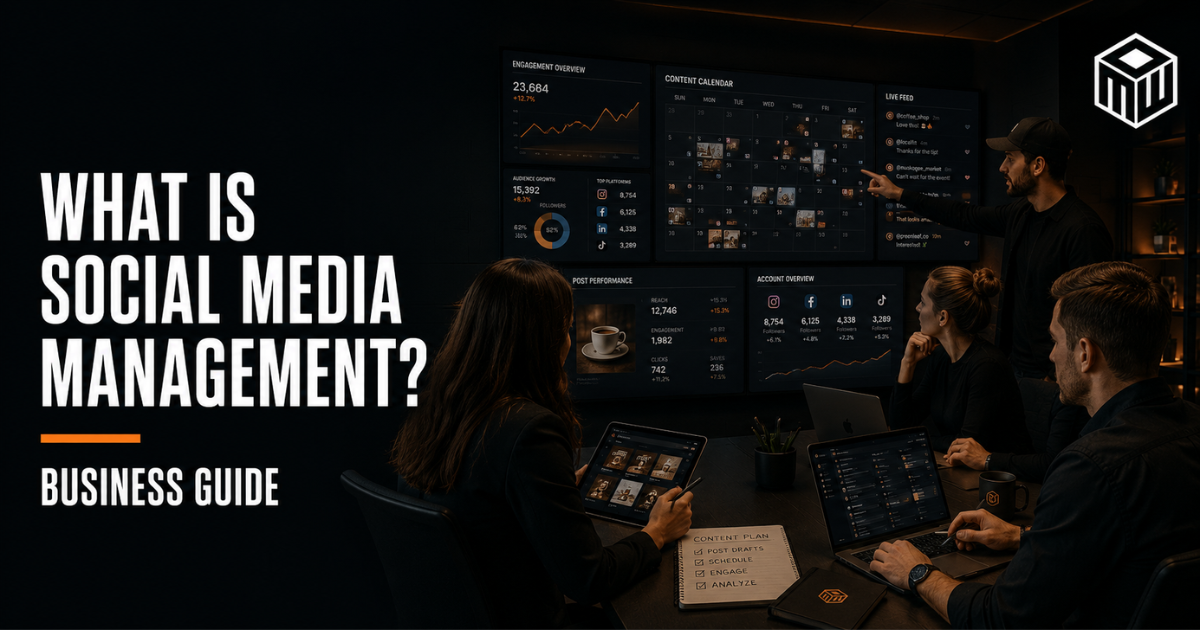
Managing business social media involves much more than writing a caption and publishing a post.
Someone needs to decide what should be published, organize the content calendar, coordinate graphics or photos, schedule approved posts, monitor comments and messages, maintain a consistent brand voice, moderate inappropriate activity, protect account access, and review what happened afterward.
Those responsibilities commonly belong to a social media manager.
A social media manager oversees the ongoing operation of a business's social media accounts. The role can include content planning, scheduling, publishing, community engagement, moderation, approval workflows, brand consistency, reporting, media organization, and account access management.
The exact responsibilities depend on the business and the scope of the role. A
social media manager working for a single-location small business may handle a relatively focused set of accounts, while someone responsible for multiple brands or locations may coordinate a much larger operation.
What Is a Social Media Manager Responsible For?
Related Articles
Author