
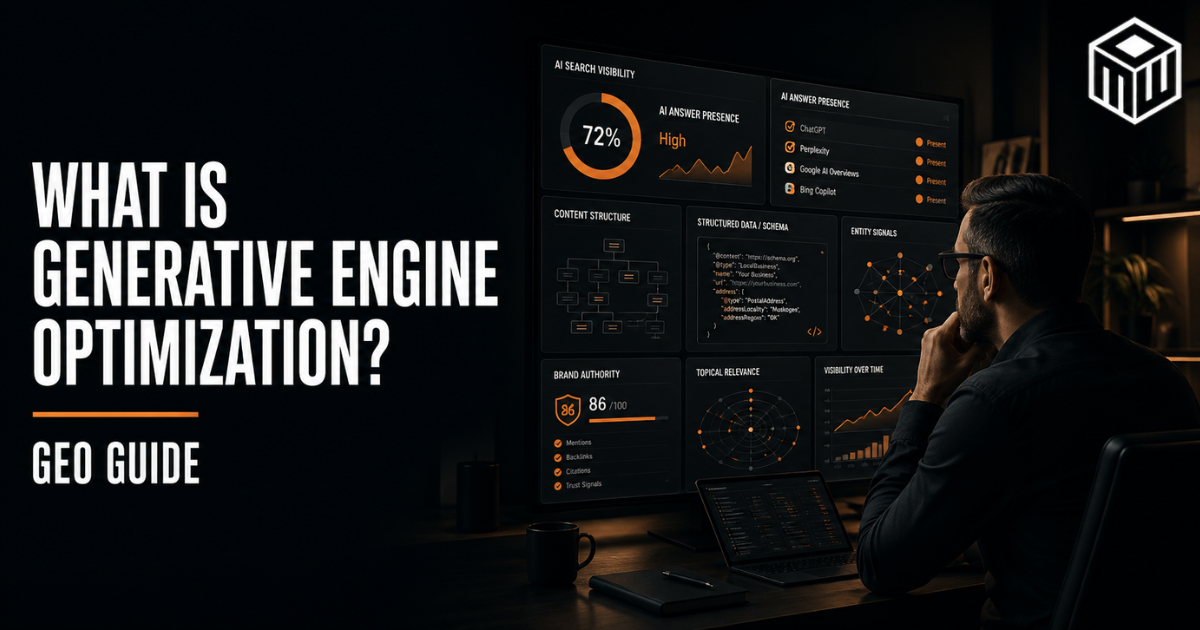
What Is Generative Engine Optimization? GEO Guide
Traditional search has often centered on a familiar interaction:
A person enters a query.
The search engine returns a collection of results.
The person chooses which result to visit.
Generative search can change that experience by providing a synthesized answer directly within the search or answer interface.
That means a business may want its information to be useful not only as a destination someone clicks but also as a source that helps inform an answer.
For example, someone researching a service may ask an AI system questions such as:
- What does this service do?
- How much does it cost?
- What should I look for in a provider?
- What is the difference between two approaches?
- Which companies provide this service?
- What should a local business consider before buying it?
Businesses that have clearly explained those subjects have created information that can potentially contribute to the broader information environment surrounding those questions.
Businesses that publish little useful information give search and answer systems much less to understand.
Professional
generative engine optimization services can help businesses evaluate how their websites, content, entities, and authority signals support visibility within these emerging search experiences.
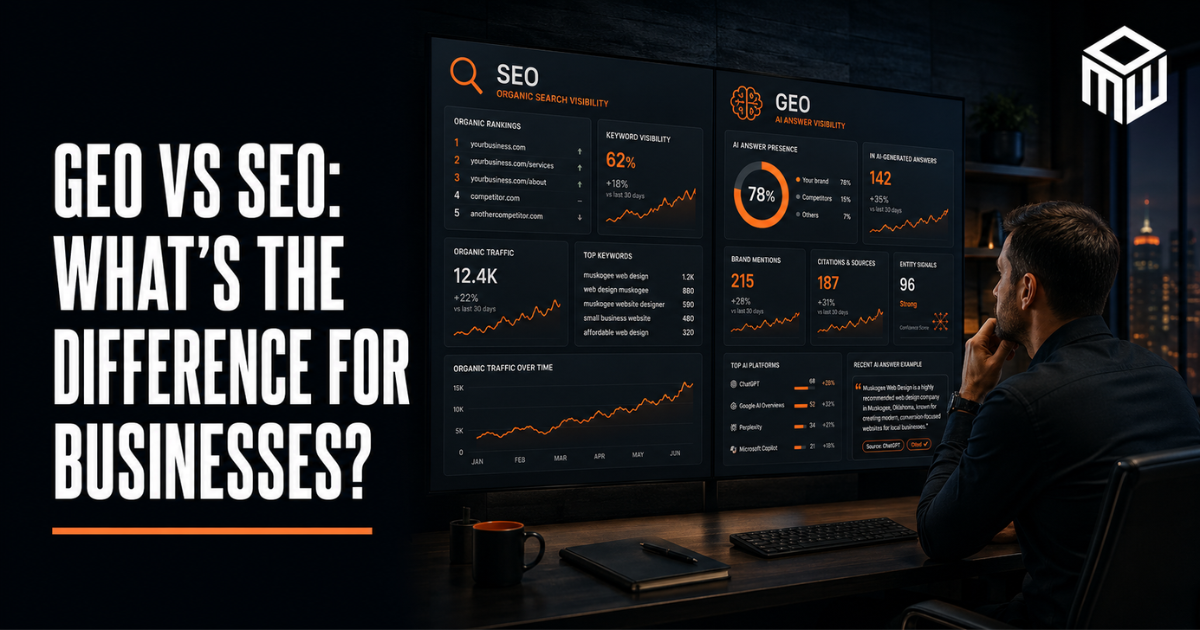
How Is GEO Different From SEO?
GEO and search engine optimization overlap substantially, but they do not have exactly the same focus.
SEO focuses primarily on earning qualified visibility and traffic from organic search results. GEO focuses on helping information become understandable, discoverable, referenced, and useful within generative search and answer experiences.
SEO may focus on questions such as:
- Can search engines crawl this website?
- Can important pages be indexed?
- What searches are customers performing?
- Does this page satisfy the search intent?
- How should pages be organized and internally linked?
- Does the site have enough authority to compete?
Those questions remain important for GEO.
Generative systems still need access to understandable information.
GEO then extends the discussion into questions such as:
- Does the content provide a clear answer that can be understood easily?
- Is it obvious which company, person, service, or topic the information refers to?
- Does the business demonstrate real expertise and authority?
- Is there original information worth referencing?
- Do other sources reinforce what the business says about itself?
- Can brand mentions and citations within generative answers be evaluated?
SEO and GEO therefore should not be treated as opposing strategies.
A strong technical and content foundation for
search engine optimization can also support the conditions GEO depends on.
For a deeper comparison, see
GEO vs SEO: What’s the Difference?
Is GEO the Same as Answer Engine Optimization?
The terms are related, but they can emphasize different aspects of search visibility.
Answer engine optimization generally focuses on helping information become suitable for direct answers.
Generative engine optimization focuses more broadly on visibility and usefulness within generative systems that may synthesize information from multiple sources into a response.
In practice, many of the underlying principles overlap.
- Clear answers matter.
- Well-organized content matters.
- Technical accessibility matters.
- Authority and credibility matter.
The terminology is still less important than the practical goal: making reliable information about the business and its expertise easier to discover and understand.
For more details, see GEO vs SEO: What's the Difference for Business?
How Do AI Search Systems Find Website Content?
Before website content can become useful in generative discovery, it generally needs to be accessible.
This creates an important connection between GEO and technical SEO.
A business can publish an excellent explanation of a topic, but that information provides limited search value if important systems cannot properly access the page.
Several technical foundations therefore matter.
Crawlability
Crawlability concerns whether automated systems can access and navigate website content.
Poor site architecture, technical restrictions, broken links, or other access problems can make important information harder to discover.
Indexability
A page also needs to be eligible for inclusion within the relevant search index or information system.
A page that is intentionally or accidentally excluded may be much less useful for search discovery.
Internal Linking
Internal links help establish relationships among pages.
For example, a broad article about generative engine optimization can link to deeper resources about structured data, entities, citations, and AI search measurement.
That structure helps readers navigate the topic while also making the relationship among pages more explicit.
Businesses with technical search problems may need to address those foundations through
search engine optimization services before expecting advanced GEO tactics to compensate for a website that is difficult to discover.
Why Does Clear Content Matter for GEO?
Generative search depends heavily on understanding information.
That makes clarity valuable.
A business website should clearly explain:
- What the company does
- Who it serves
- What services it provides
- Where it operates
- How important processes work
- What terms mean
- What problems customers face
- How different options compare
- What evidence supports important claims
This does not mean writing unnaturally short sentences for machines.
It means removing unnecessary ambiguity.
Consider two descriptions.
One company writes:
“We deliver transformative solutions designed to help organizations achieve next-level outcomes.”
Another writes:
“We design and manage business websites, provide SEO and content marketing services, and help companies improve online visibility and conversions.”
The second description provides much clearer information about what the business actually does.
Clear writing benefits people first.
It also creates stronger contextual signals for systems trying to understand the subject.
Does GEO Mean Writing Content for AI Instead of People?
No.
Useful GEO content should still be written for the people who need the information.
Creating awkward pages filled with repetitive definitions, unnatural keywords, or mechanically structured “AI answers” can make the website less useful.
A better approach is to satisfy the human question thoroughly and clearly.
That includes:
- Answering the main question early
- Explaining important context
- Using descriptive headings
- Addressing related customer questions
- Providing examples when useful
- Connecting related concepts naturally
- Demonstrating expertise
- Maintaining factual accuracy
The same content can then be easier for both readers and search systems to understand.
GEO should improve information quality rather than give businesses a reason to publish lower-quality machine-focused content.
Why Does Original Information Matter?
Generic information is easy to reproduce.
A business creates greater informational value when it can contribute something based on genuine expertise or evidence.
Original information might include:
- First-party research
- Original surveys
- Internal data that can responsibly be shared
- Documented processes
- Expert analysis
- Firsthand observations
- Case studies
- Real project examples
- Industry-specific insights
- Useful frameworks developed through experience
That does not mean every article needs groundbreaking research.
A business can add value simply by explaining an important subject more clearly from real experience.
Suppose hundreds of websites already define conversion optimization.
A company that can explain the specific problems it regularly evaluates during real website projects can contribute something more useful than another generic definition.
This relationship is why GEO naturally connects with
content marketing services.
Content marketing helps businesses develop the useful information. GEO considers how that information contributes to understanding and discovery within generative experiences.
Why Does Expert-Led Content Matter?
Expertise gives content substance.
Anyone can produce a generic list of recommendations.
More valuable content explains why those recommendations matter, when they apply, what tradeoffs exist, and what experience supports them.
Expert-led content may include input from:
- Business owners
- Technical specialists
- Designers
- Marketers
- Industry professionals
- Subject-matter experts
- Employees working directly with customers
The author or contributor should be able to support what the content says.
Businesses should not invent expertise, projects, statistics, testimonials, or first-person experience merely to make an article appear authoritative.
Credibility depends on the information being genuine.
What Is Entity Optimization?
An entity is a distinct person, organization, location, product, service, or other identifiable concept.
For a business, entity optimization involves making it easier to understand that the company is a specific organization connected with particular people, services, locations, topics, and other facts.
Consider the basic questions someone might ask about a company:
- What is the company called?
- What does it do?
- Where does it operate?
- Who is associated with it?
- What services does it provide?
- What topics does it have expertise in?
- Where else is the company mentioned?
Consistent information helps reinforce those relationships.
This makes GEO partly a branding challenge.
A business whose name, descriptions, services, positioning, and other important information vary dramatically across its online presence can create unnecessary ambiguity.
Professional
branding services can help establish the identity and messaging foundation that entity signals should consistently represent.
Why Does Brand Authority Matter?
Generative visibility is not only about what a business says about itself.
Information from other sources can also influence how recognizable and credible a brand appears within its broader subject area.
Brand authority can be supported through things such as:
- Useful expert content
- Relevant third-party mentions
- Industry recognition
- Citations
- Customer reviews
- Partnerships
- Original research
- Earned media
- Consistent business information
- Demonstrated expertise
This does not mean collecting random mentions anywhere on the internet.
Relevance and credibility matter.
A legitimate mention of a business from a respected source within its field is more meaningful than creating dozens of low-quality references solely to make the company appear popular.
Authority is generally built rather than manufactured.
How Do Third-Party Brand Mentions Support GEO?
A company's website represents what the business says about itself.
Third-party sources can provide additional context.
Suppose a company claims to specialize in a certain service.
If customers, industry organizations, publications, partners, directories, or other credible external sources independently connect that company with the same service, the broader information environment becomes more consistent.
This is one reason brand building, public relations, reputation, SEO, and GEO can overlap.
The goal should not be to place the company name everywhere possible.
The goal is to earn relevant mentions where the business genuinely belongs.
What Role Does Structured Data Play?
Structured data gives machines explicit information about page content and entities in a standardized format.
Depending on the page, structured data may help clarify information such as:
- The organization behind a website
- Article information
- Authors
- Breadcrumbs
- Products
- Services
- Other defined entities or content types
Structured data should accurately represent information already present on the website.
It should not be treated as a shortcut that compensates for weak content.
Adding markup to a vague, unhelpful page does not suddenly make the underlying information authoritative.
Structured data supports understanding.
It does not replace useful content, technical accessibility, or credibility.
Do FAQ Sections Help With Generative Search?
FAQ sections can be useful when they answer genuine customer questions.
Their value comes from the information, not merely from placing content beneath an FAQ heading.
A useful FAQ can clarify important follow-up questions that do not require full sections elsewhere in the article.
An unhelpful FAQ simply repeats the same keyword in several slightly different questions.
The better approach is to ask:
What would a real reader reasonably want to know next?
Answer those questions clearly.
If the questions deserve substantial explanation, they may eventually justify separate supporting articles rather than increasingly expanding the FAQ section.
Does a Website Need llms.txt for GEO?
The GEO landscape includes discussion of technical files and emerging conventions such as llms.txt.
However, GEO should not be reduced to one file or technical implementation.
A website still needs strong foundational qualities such as accessible content, clear information, technical search health, useful expertise, consistent entity signals, and credible authority.
Whether a particular emerging technical convention should be implemented is a narrower question than whether the overall business is prepared for generative discovery.
Can AI-Generated Content Be Used for GEO?
he important issue is not simply whether AI assisted with production.
The important issue is whether the finished content is accurate, useful, original enough to provide real value, and supported by appropriate expertise.
Mass-producing generic pages does not create authority merely because more URLs exist.
Businesses need useful information worth discovering.
AI tools may assist with parts of a content workflow, but the business remains responsible for what it publishes.
Content should be reviewed for factual accuracy, relevance, duplication, unsupported claims, and whether it actually helps the intended audience.
How Does Web Design Affect GEO?
GEO is not only a content-writing issue.
The website provides the structure through which information is presented.
Good
business web design can support GEO by making important business information logically organized, accessible, usable, and connected.
Consider a service company whose website has no individual service pages.
Every service is mentioned briefly in one paragraph on the homepage.
The business may understand its offerings internally, but the website gives readers and search systems very little detailed information about each one.
A more deliberate website architecture can create clear destinations for major services, educational topics, company information, and other important entities.
That structure also creates better places for content to link as readers move through their research.
How Does GEO Help Local Businesses?
Local businesses may have an additional goal: making clear what the company does and where it operates.
Important information can include:
- Business name
- Services
- Locations
- Service areas
- Contact information
- Business descriptions
- Relevant customer reviews
- Local expertise
- Consistent information across important online properties
A local business that clearly establishes its services and geographic relevance gives both customers and search systems stronger context.
Local GEO therefore overlaps heavily with local SEO and broader brand/entity management.
It should not be approached as a completely isolated tactic.
How Does GEO Work for Service Businesses?
Service businesses often have substantial opportunities to create useful information because customers ask many questions before hiring them.
Those questions may involve:
- Definitions
- Costs
- Timelines
- Processes
- Comparisons
- Problems
- Risks
- Qualifications
- Alternatives
- Buying decisions
Each question can become part of a broader body of expert information.
For example, a web design company should not have only one page saying it offers web design.
It can explain what makes a good website, what websites cost, how long projects take, when redesigning makes sense, what pages businesses need, how mobile design works, and how design affects conversions.
The service page addresses the commercial offering.
Supporting content establishes deeper knowledge around the subject.
This relationship between service pages and educational content can help both people and search systems understand what the business actually specializes in.
How Do You Measure GEO?
GEO measurement is broader than watching a traditional ranking position.
Businesses may want to understand whether their brand and content are appearing within generative search experiences and how those appearances change over time.
Potential areas of measurement include:
- Traffic arriving from AI search platforms
- Brand mentions in AI answers
- Citations or references to website content
- Which pages are being referenced
- Which topics generate visibility
- Whether important company information is represented accurately
- Changes in visibility over time
Measurement can be difficult because generative answers may vary by query, context, platform, and timing.
That makes GEO measurement an emerging discipline rather than a single universal metric.
Businesses should avoid reducing success to one number.
The more useful question is whether relevant audiences and generative systems are increasingly encountering accurate, useful information associated with the business.
What Should a Business Optimize First for GEO?
Start with fundamentals rather than chasing isolated tactics.
1. Make Sure Important Content Can Be Discovered
Review crawlability, indexability, internal links, and website structure.
If important pages are difficult for search systems to access, correct that foundation first.
2. Clearly Explain the Business
Make sure the website answers fundamental questions about the company, services, customers, expertise, and locations.
Avoid vague marketing language that makes basic facts unnecessarily difficult to determine.
3. Build Useful Topic Depth
Create genuinely useful content around the questions customers ask before, during, and after the buying decision.
Organize related information into clear topic clusters.
4. Add Genuine Expertise
Use subject-matter knowledge, processes, examples, observations, and original information where the business truly has something useful to contribute.
5. Strengthen Entity Consistency
Make important information about the company consistent and clear across relevant online sources.
6. Build Brand Authority
Earn relevant recognition, mentions, reviews, citations, and relationships rather than manufacturing low-quality signals.
7. Use Structured Information Appropriately
Implement relevant structured data where it accurately represents the page and improves machine understanding.
8. Measure Generative Visibility
Track meaningful brand mentions, citations, referral traffic, and other available signals over time.
This creates a stronger GEO foundation than searching for one secret optimization tactic.
Frequently Asked Questions
What is generative engine optimization in simple terms?
Generative engine optimization is the process of making a business, website, and content easier for AI-driven search and answer systems to understand, discover, reference, and use.
What does GEO stand for in digital marketing?
What does GEO stand for in digital marketing?
GEO stands for generative engine optimization.
It refers to optimization focused on visibility and usefulness within generative search and AI answer experiences.
Is GEO replacing SEO?
No.
GEO and SEO overlap heavily.
SEO remains important for organic search visibility and provides technical and content foundations such as crawlability, indexability, site structure, and useful search-focused content.
GEO extends those foundations toward generative search and answer visibility.
Does GEO guarantee that AI systems will cite my website?
No.
A business cannot reasonably guarantee that a particular AI system will cite or mention a webpage for a particular question.
GEO focuses on improving the factors the business can control: accessibility, clarity, content quality, entity signals, authority, original information, and overall usefulness.
Do I need separate content for GEO and SEO?
Not necessarily.
Useful, well-structured, expert-led website content can support both traditional organic search and generative discovery.
Businesses generally should not create near-duplicate versions of the same information solely to label one “SEO content” and another “GEO content.”
Is structured data required for GEO?
Structured data can support machine understanding, but it is only one part of a broader foundation.
It does not replace useful content, technical accessibility, brand authority, or clear entity information.
Can small businesses benefit from GEO?
Yes.
Small and local businesses can improve how clearly their services, locations, expertise, and brand are represented online.
GEO can be especially relevant when potential customers use AI-driven tools to research services, compare options, or find businesses.
How long does GEO take to work?
There is no universal timeline.
GEO can involve technical improvements, content development, authority building, entity strengthening, and measurement over time.
Some improvements can be implemented quickly, while building a substantial body of expert content and broader brand authority is a longer-term process.
Conclusion
Generative engine optimization is about preparing a business for a search environment where discovery increasingly includes AI-generated answers as well as traditional search results.
The goal is not to trick generative systems.
It is to make the business and its information easier to
understand, discover, reference, and use.
That begins with familiar fundamentals: crawlable websites, indexable pages, logical structure, useful content, and clear business information.
GEO then extends those foundations through entity signals, brand authority, original expertise, structured information, third-party mentions, clear answers, and measurement of generative visibility.
SEO helps businesses earn organic search visibility.
Content marketing develops useful information.
Branding strengthens identity and entity consistency.
Web design provides an accessible, organized destination.
GEO connects those foundations with the growing challenge of visibility inside generative search and answer experiences.
If your business has invested in SEO and content but is unsure how well your website, brand, and expertise are prepared for AI-driven search, Muskogee Web Design can help evaluate that next layer of visibility.
Our
generative engine optimization services focus on helping brands and content become more understandable, discoverable, referenceable, and useful within generative search experiences.
When you are ready to discuss your website, content, search visibility, and AI discovery strategy,
book a generative engine optimization consultation.
People increasingly use AI-driven search and answer experiences to research businesses, compare options, understand complicated subjects, and get direct answers to questions.
That creates a new visibility challenge for businesses.
It is no longer enough to think only about whether a webpage can appear as a traditional organic search result. Businesses also need to consider whether their information is clear enough to be understood, connected with the correct company or entity, and useful enough to contribute to generative answers.
That is where generative engine optimization comes in.
Generative engine optimization, commonly called GEO, is the practice of improving a brand, website, and content so they are easier for AI-driven search and answer systems to understand, discover, reference, and use when generating responses.
GEO can involve technical foundations such as crawlability and indexability, clear and useful content, structured information, entity signals, brand authority, original expertise, and third-party mentions.
The objective is not to manipulate an AI system into mentioning a business.
The objective is to make the business and its information clear, credible, accessible, and useful enough to be considered within generative discovery.
Why Does Generative Engine Optimization Matter?
Related Articles
Author