

What Is SEO and How Does It Work for Business?
At a high level, SEO works by helping search engines discover website content, understand what that content is about, and determine when it may be useful for a particular search.
That process depends on several connected areas.
A website first needs pages that search engines can access.
Those pages need to contain understandable information.
The content needs to match questions and needs people actually search for.
The website should clearly establish relationships among its important pages.
Technical problems should not prevent people or search engines from using the site properly.
External signals can also help establish the website's broader authority and relevance.
SEO brings those areas together.
It is therefore better understood as an ongoing system than as one individual tactic.
Professional
search engine optimization services can help businesses evaluate and improve those different parts of organic search visibility as a coordinated strategy.
What Happens When a Search Engine Finds a Website?
Search visibility begins with discovery.
Search engines use automated systems to find pages and follow links between them. Once content is discovered, it can be processed and evaluated for potential inclusion in search results.
This creates several basic SEO requirements.
Search Engines Need to Find the Page
An important page provides little organic search value if search systems have difficulty discovering it.
Internal links, logical website architecture, and a technically accessible site can all help important pages become easier to find.
Search Engines Need to Understand the Page
The page should make its purpose clear.
A service page about website management should contain useful information about website management.
An article explaining business website costs should actually answer questions about pricing.
Clear titles, headings, page copy, links, and supporting context can all help establish what a page is about.
The Page Needs to Be Relevant to the Search
A page about logo design is unlikely to be the most useful result for someone searching for website maintenance.
SEO therefore depends heavily on matching pages with the needs behind actual searches.
This is where keyword research and search intent become important.
What Is Keyword Research?
Keyword research is the process of understanding the words and phrases people use when searching for information related to a business.
A keyword does not always mean one short phrase.
People search in many different ways.
For example, someone interested in website pricing might search:
- “business website cost”
- “how much does a website cost”
- “professional website pricing”
- “how much should a small business spend on a website”
Those searches express closely related needs.
A business generally does not need a separate page for every wording variation.
One strong resource can address the overall intent naturally.
Keyword research helps businesses identify subjects customers care about and understand how those needs are expressed through search.
It can also reveal different stages of the customer journey.
Someone searching “what is branding?” is primarily looking for education.
Someone searching “how much does branding cost?” has a more commercial question.
Someone searching “how to choose a branding agency” may be close to hiring a provider.
The search terms are different because the customer needs are different.
What Is Search Intent?
Search intent is the reason behind a search.
Understanding intent is one of the most important parts of SEO because ranking for a phrase is not useful when the page fails to provide what the searcher actually wants.
Common search intents can include:
- Learning about a subject
- Solving a problem
- Comparing options
- Evaluating cost
- Finding a local business
- Choosing a provider
- Purchasing a product or service
Consider the difference between:
“What is SEO?”
and:
“How much does SEO cost?”
The first search requires an educational explanation.
The second requires pricing information and an explanation of what affects cost.
Trying to force both searches onto the same page can make the page less useful for either reader.
SEO works best when each important page has a clear primary purpose.
What Is On-Page SEO?
On-page SEO involves improving the content and elements of an individual webpage so its purpose is clear and the page serves its intended search need effectively.
That can include areas such as:
- Page titles
- Headings
- Main content
- Internal links
- Images
- URLs
- Meta descriptions
- Content organization
Good on-page SEO should not make writing sound unnatural.
A page does not become more useful because the same keyword appears repeatedly.
Instead, the subject should be explained naturally using the terminology necessary to answer the reader's question.
For example, an article about website maintenance may naturally discuss backups, security, software updates, uptime, forms, performance, and content updates.
Those concepts belong together because they are part of the subject.
That gives search systems stronger context while also helping the reader understand the topic more completely.
Does SEO Mean Putting Keywords Everywhere?
No.
Keyword stuffing is not a useful SEO strategy.
Businesses sometimes assume that if using an important phrase once is helpful, repeating it twenty times must be better.
The result is usually awkward content.
Consider if we used this sentence on our website:
“Our Muskogee SEO company provides Muskogee SEO services for businesses needing Muskogee SEO from an SEO company in Muskogee.”
The subject may be obvious, but the sentence is not useful.
Natural language works better because real subjects include related concepts.
An SEO article might naturally discuss organic visibility, search intent, content, links, technical performance, local search, rankings, and conversions.
Those ideas reinforce the subject without requiring repetitive wording.
The goal is to make the page useful and understandable, not to reach an arbitrary keyword frequency.
Why Is Useful Content Important for SEO?
Search engines need information to connect searches with relevant pages.
That makes content central to many SEO strategies.
Businesses can create pages addressing questions customers ask throughout the buying process.
A web design company, for example, might publish resources answering:
- How much does a website cost?
- How long does a website take to build?
- What makes a good business website?
- Should I redesign my existing site?
- What pages does my website need?
Each article addresses a distinct customer need while demonstrating deeper expertise around web design.
This creates a body of related information rather than one page trying to answer every possible question.
Professional
content marketing services can support this process by organizing customer questions into useful topic clusters and producing content that supports both customer education and search visibility.
What Are Topic Clusters?
Topic clusters organize related content around major areas of business expertise.
Instead of publishing hundreds of unrelated articles, a company can build depth around the subjects most closely connected to its services.
For example, an SEO cluster might include:
- What Is SEO and How Does It Work?
- Why Is SEO Important for Small Businesses?
- How Long Does SEO Take to Work?
- How Much Does SEO Cost?
- What Is Keyword Research?
- What Is Search Intent?
- What Is Technical SEO?
- What Are Backlinks?
- What Is Local SEO?
- How to Measure SEO Performance
Each article answers a different question.
Internal links connect them.
Together, they make the relationship between the subjects easier for readers and search engines to understand.
The purpose is not to build artificial silos.
It is to organize information logically.
What Is Technical SEO?
Technical SEO focuses on website issues that can affect how search engines access, understand, and process site content.
That can involve areas such as:
- Crawlability
- Indexability
- Site structure
- Website performance
- Mobile usability
- URLs
- Internal links
- Technical errors
A website can contain excellent content and still struggle if technical problems prevent important pages from being accessed properly.
For example, a page could accidentally be excluded from search indexing.
Important pages might be hidden behind poor navigation.
Broken internal links could interfere with how content is connected.
A slow or malfunctioning website can also create problems for visitors.
Some technical SEO issues cross directly into ongoing
website management services, particularly when problems involve performance, software, website health, broken functionality, or other maintenance responsibilities.
Does Website Speed Affect SEO?
Website performance matters because a slow experience can make a website harder to use.
Visitors may become frustrated when important pages take too long to load or interactions respond poorly.
Performance problems can come from many sources, including:
- Oversized images
- Excessive scripts
- Unnecessary software
- Poor hosting
- Third-party tools
- Technical configuration problems
Speed should not be treated as an isolated score that matters more than everything else.
A very fast page containing weak or irrelevant information is still not a good search result.
The goal is a technically sound website that also provides useful content.
Does Mobile Usability Matter for SEO?
Yes.
People search and browse from phones, tablets, laptops, and other devices.
A business website should provide a usable experience across appropriate screen sizes.
Mobile problems can include:
- Text that is difficult to read
- Buttons that are difficult to use
- Navigation that does not function correctly
- Content extending beyond the screen
- Forms that are frustrating to complete
- Slow mobile performance
These are not merely technical concerns.
They affect whether the person can actually use the website after finding it.
That is why SEO overlaps with [professional web design services, https://muskogee-web-design.com/product/web-design].
SEO helps people discover the website.
Web design and user experience influence what happens after they arrive.
What Are Internal Links?
Internal links connect pages within the same website.
For example, this article can link to a deeper resource explaining keyword research.
That keyword research article might later link to a guide about choosing keywords.
Those links help readers continue learning without having to return to search after every question.
Internal links can also clarify relationships among website topics.
A website might connect:
- SEO content to Content Marketing.
- Website performance content to Web Management.
- Search-focused design topics to Web Design.
- AI search topics to GEO.
The anchor text should explain what the destination is about.
Descriptive wording such as “technical SEO” provides more context than generic wording such as “click here.”
What Are Backlinks?
A backlink is a link from another website to yours.
Backlinks can help people discover resources and can contribute to the broader authority and reputation surrounding a website.
However, not all backlinks are equally valuable.
A relevant link from a credible source within an appropriate context is different from a large collection of low-quality links created solely to manipulate search visibility.
Businesses should focus on becoming genuinely worth referencing.
That may happen through:
- Useful resources
- Original research
- Expert insights
- Industry relationships
- Partnerships
- Earned media
- Helpful tools
- Strong business reputation
This is a stronger long-term approach than simply trying to collect the largest possible number of links.
What Is Local SEO?
Local SEO focuses on helping businesses become more visible for searches with geographic relevance.
It can be particularly important for businesses serving customers in specific cities, regions, or service areas.
Local search visibility can involve signals related to:
- Business information
- Location relevance
- Services
- Google Business Profiles
- Customer reviews
- Website content
- Local authority
- Consistency across relevant online sources
A local service business should make it easy to understand what it does and where it operates.
That does not mean creating near-identical articles for every nearby city.
Location-specific content is more valuable when there is a genuine reason for it to exist, such as unique services, projects, customer needs, market conditions, or local information.
How Do Google Business Profiles Relate to SEO?
For many local businesses, a Google Business Profile is an important part of local search visibility.
It gives customers another way to encounter business information when searching locally.
Businesses should make sure important information is accurate and consistent with their broader online presence.
The profile does not replace the website.
A business website provides greater space to explain services, demonstrate expertise, publish useful resources, show proof, and guide visitors through more complicated decisions.
The profile and website should support one another rather than being treated as alternatives.
How Does Web Design Affect SEO?
SEO and web design intersect in several important areas.
The website determines how content is structured and experienced.
Design decisions influence navigation, mobile usability, page hierarchy, calls to action, accessibility, and how easily visitors can move through information.
A visually impressive website can still create search problems when important services have no dedicated pages or navigation makes information difficult to discover.
Likewise, a website designed only around search terms can create a poor customer experience.
The strongest approach gives both needs appropriate attention:
- Can relevant people discover the page?
- Can they understand and use it once they arrive?
Does Better SEO Automatically Mean More Leads?
No.
SEO can increase qualified visibility and traffic, but the website still has to turn that opportunity into business results.
Suppose a service page begins attracting significantly more organic visitors.
If the page provides weak information, creates little trust, hides the contact option, or has a broken form, more traffic may not produce proportionally more leads.
This is where SEO and conversion optimization intersect.
SEO asks:
- Can the right people discover this page?
Conversion optimization asks:
- What happens after they arrive?
Businesses receiving meaningful traffic but struggling to convert visitors may need
conversion optimization services in addition to traffic acquisition work.
How Is SEO Different From PPC?
SEO focuses on organic search visibility.
PPC, or pay-per-click advertising, involves paying for advertising placements that can appear for selected searches.
The approaches have different advantages and tradeoffs.
SEO usually involves building website content, technical health, authority, and search visibility over time.
PPC can purchase immediate visibility for appropriate searches as long as the campaign is active and sufficiently funded.
Businesses may use one or both depending on their goals, competition, budget, timeline, and customer acquisition strategy.
Professional
search engine marketing services address the paid-search side of that equation.
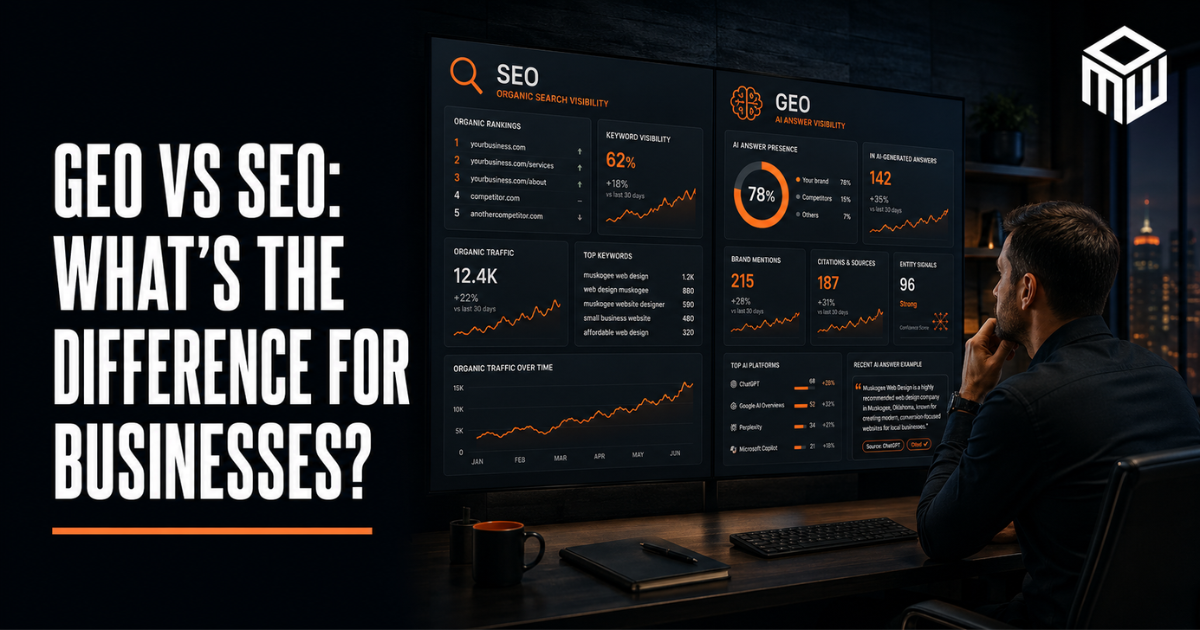
How Is SEO Different From GEO?
SEO focuses on traditional organic search visibility and traffic.
Generative engine optimization, or GEO, expands the visibility discussion into AI-driven search and answer experiences.
GEO can consider whether a brand and its content are understandable, discoverable, referenced, cited, or otherwise useful within generated answers.
The strategies overlap heavily.
Technical accessibility, useful content, clear answers, authority, and organized website information can support both.
GEO adds further attention to areas such as entities, AI citations, brand mentions, original information, and generative visibility measurement.
Businesses preparing for both traditional and AI-driven search can connect SEO with
generative engine optimization services.
How Long Does SEO Take to Work?
SEO is generally not an immediate process.
The time required depends on factors such as the website's current condition, competition, existing authority, technical problems, content, target searches, and the amount of work required.
Some improvements can be implemented quickly.
For example, a technical problem may be corrected in a short period.
Building strong visibility across competitive topics may require much more sustained work.
The better question is not simply how many days SEO takes.
Businesses should ask what needs to change between their current search presence and the visibility they want.
How Do You Measure Whether SEO Is Working?
SEO should be measured against meaningful goals rather than a single ranking.
Useful indicators can include:
- Organic search visibility
- Impressions
- Clicks
- Organic website traffic
- Performance of important pages
- Qualified leads
- Calls
- Consultation requests
- Sales
- Other relevant conversions
Rankings can be useful diagnostic information, but ranking for searches that never produce meaningful visitors is not necessarily a strong business result.
Traffic also requires context.
A company might attract thousands of readers to a broad informational article while receiving fewer visitors on a high-intent service page.
The service page may still contribute more directly to revenue.
Good SEO measurement connects search performance with the job each page is intended to perform.
Why Doesn't SEO Stop After a Website Ranks?
There are several valid reason, which include:
- Search environments change.
- Competitors publish new content.
- Businesses add and remove services.
- Customer search behavior changes.
- Websites develop technical issues.
- Content becomes outdated.
- New opportunities appear.
That means SEO requires ongoing attention.
A page that performs well today should still be maintained when its information changes or better resources become available.
Ongoing SEO does not mean rewriting every successful page constantly.
It means continuing to evaluate whether the website remains technically healthy, useful, relevant, competitive, and aligned with business goals.
What Should a Small Business Do First With SEO?
Start with the fundamentals.
Make Sure the Website Clearly Explains the Business
Customers and search engines should be able to determine what the company offers, who it serves, and where appropriate, where it operates.
Create Strong Pages for Major Services
Important services deserve useful pages rather than one vague sentence on the homepage.
Identify Real Customer Questions
Collect the problems, comparisons, costs, and decisions customers repeatedly research.
These can become useful supporting content.
Review Technical Health
Make sure important pages are accessible, functional, mobile-friendly, and reasonably performant.
Build Logical Internal Links
Connect services, supporting articles, and related resources so people can navigate the subject naturally.
Strengthen Authority Over Time
Create useful information worth referencing and build a legitimate business reputation rather than relying on shortcuts.
Track Meaningful Results
Measure whether search visibility is producing relevant visitors and business opportunities.
SEO does not need to begin with hundreds of pages or complicated tactics.
A strong foundation of useful pages, clear site structure, technical health, and real expertise can create a much better starting point.
Frequently Asked Questions
What does SEO stand for?
SEO stands for
search engine optimization.
It refers to the process of improving a website's ability to earn qualified visibility and traffic through organic search results.
What is SEO in simple terms?
SEO helps make a website easier to find when people search for relevant information, products, or services.
It can involve content, keywords, technical improvements, links, local search optimization, and other work that strengthens organic search visibility.
Is SEO free?
Organic search results are not purchased in the same way as paid advertisements.
However, SEO itself requires resources.
A business may invest time internally or pay professionals for research, content, technical improvements, strategy, implementation, and measurement.
Does SEO guarantee first place on Google?
No legitimate SEO strategy can guarantee a permanent number-one position for every target search.
Search results depend on many factors outside a business's direct control, including competition and the search engine's own systems.
SEO improves the parts the business can control.
How do keywords help SEO?
Keywords help businesses understand how customers express their needs through search.
They can guide page topics and content planning, but they should be used naturally rather than repeated excessively.
Do businesses need backlinks for SEO?
Backlinks can contribute to discovery and authority, but quality and relevance matter.
Businesses should focus on earning legitimate links and references rather than creating large numbers of low-quality links solely for SEO.
Is local SEO different from regular SEO?
Local SEO focuses specifically on searches where geographic relevance matters.
It can include local business information, location relevance, reviews, Google Business Profiles, website content, and other local signals.
Can SEO work for small businesses?
Yes.
SEO can help small businesses connect with people actively searching for relevant services, products, problems, and local providers.
The appropriate strategy depends on the business, market, competition, and available resources.
Conclusion
SEO is the process of improving a website's ability to earn qualified visibility and traffic from organic search.
It works by strengthening several connected areas.
Search engines need to discover important pages.
They need to understand what those pages are about.
The content needs to satisfy relevant search intent.
The website needs a sound technical foundation and logical structure.
Internal and external signals can help establish relationships, relevance, and authority.
But rankings and traffic are not the final objective.
For a business, successful SEO should help the right people find useful information and move toward meaningful customer actions.
That is why SEO connects naturally with content marketing, website management, web design, conversion optimization, and increasingly generative engine optimization.
Organic search visibility is one part of a larger customer journey.
The strongest SEO strategy builds visibility while making sure the website deserves the attention once it receives it.
If your business has a website but struggles to appear for the searches potential customers use—or you are unsure whether technical problems, content gaps, weak authority, or site structure are limiting visibility—Muskogee Web Design can help evaluate the opportunity.
Our
search engine optimization services focus on building qualified organic visibility around the services, topics, and customer searches that matter to your business.
When you are ready to discuss your current search visibility and what may be limiting it,
book an SEO consultation.
When someone searches online for a product, service, answer, or local business, search engines have to determine which pages are most relevant and useful for that search.
Search engine optimization helps businesses improve the information, structure, technical foundation, and authority of their websites so they have a better opportunity to appear for relevant searches.
SEO, or search engine optimization, is the process of improving a website's visibility in organic search results so the right people can discover the business when they search for relevant information, products, or services.
SEO can involve keyword and search-intent research, useful content, page optimization, technical website improvements, internal links, backlinks, local search signals, website usability, and ongoing performance measurement.
The goal is not simply to attract more visitors.
Effective SEO aims to attract
qualified visitors—people whose searches have a meaningful connection to what the business offers.
How Does SEO Work?
Related Articles
Author